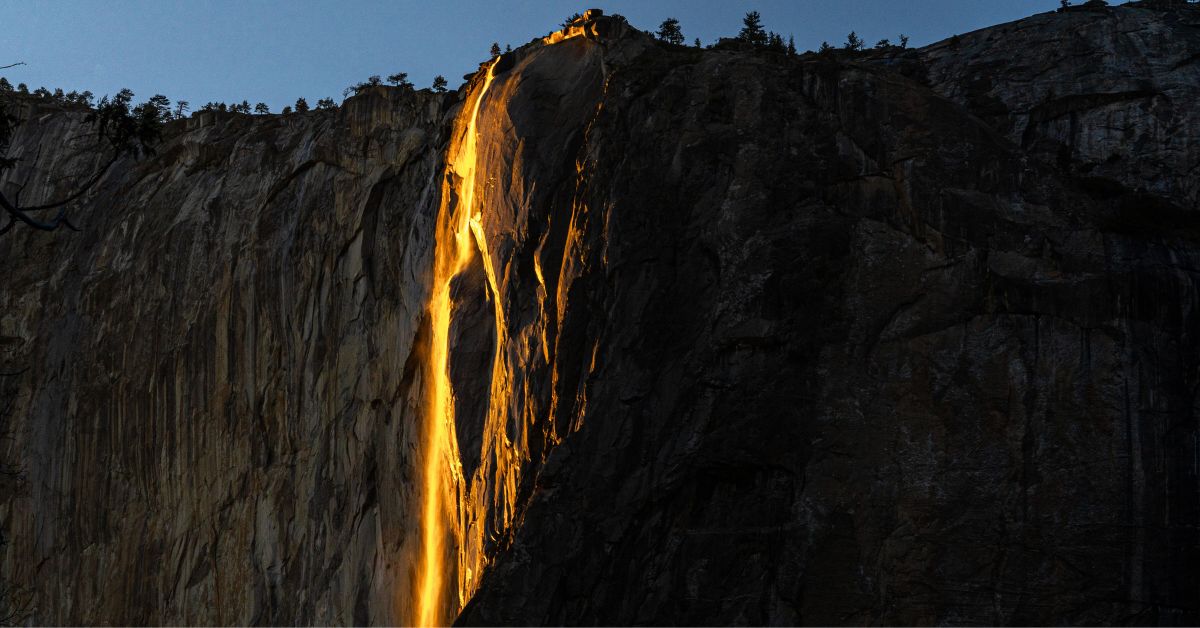
Yosemite’s Firefall is a rare natural phenomenon that occurs at Horsetail Fall, an ephemeral waterfall on the eastern face of El Capitan! 🤩
For a brief window in winter, usually about two weeks in February, the setting sun can hit the waterfall at just the right angle, causing the water to glow bright orange and red, almost like lava spilling down the granite cliff.
When the conditions are perfect (clear skies, enough flowing water, and the right sunset angle) Horsetail Fall transforms into what’s known as the Yosemite Firefall. It’s unpredictable, fleeting, and completely mesmerizing, which is why thousands of people flock to the park each year hoping to witness it.
My husband and I saw the Horsetail Fall Firefall for the first time in 2025. Before going, I was honestly a little anxious about the crowds. Even with the reservation system in place that year, I knew the main viewing area was going to be packed. And it was. 😧
But despite the crowds, it was an incredible experience. Everyone was respectful and patient, waiting quietly for the waterfall to glow.
When the Firefall finally started, the crowd went silent. I felt such a strong sense of community as my husband, myself, and hundreds of strangers stood together, completely in awe, sharing the same unforgettable moment.
It was truly worth the wait. If you love seeing nature do rare and unique things, this experience is absolutely for you! 🫵
Just be prepared for a bit of chaos, especially if you’re planning to visit during Presidents’ Day weekend, when crowds are at their busiest.
My complete first-timer’s Yosemite Firefall 2026 guide is here to help! You’ll find everything you need to know about visiting Yosemite during Firefall season, including what to expect, the best time to go, the best viewing spot, what to bring, where to stay, and essential tips to make your trip less chaotic and far more enjoyable. 🙌
Affiliate Disclaimer: Some links on this page may be affiliate links, meaning I may earn a small commission at no extra cost to you. As an Amazon Associate, I earn from qualifying purchases. Thanks for supporting the blog! 🫶
Yosemite Firefall: Know Before You Go
🔥 What is Yosemite Firefall?
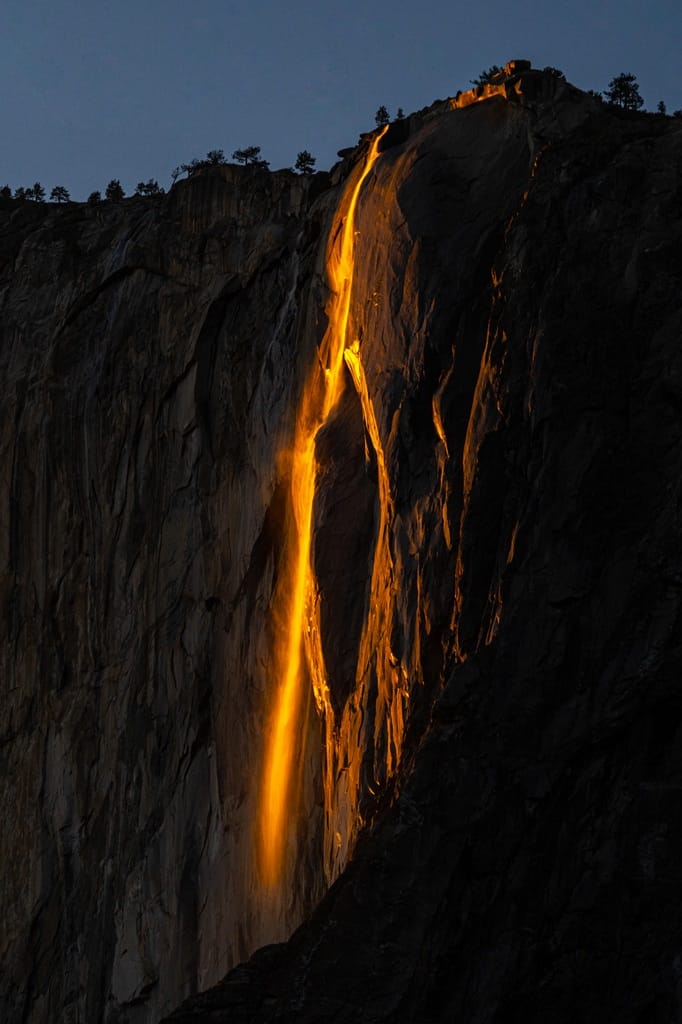
Horsetail Fall is a small, seasonal waterfall that spills over the eastern edge of El Capitan in Yosemite Valley.
Because it only flows during the winter months, it’s easy to miss for most of the year. Fed entirely by snowmelt and runoff, the waterfall usually dries up by summer and disappears completely.
What makes Horsetail Fall famous is Yosemite’s modern-day “Firefall.”
On rare evenings in mid to late February, the setting sun hits the waterfall at just the right angle, causing the water to glow bright orange and red. It literally looks like lava!
Despite its dramatic 2,130-foot drop, Horsetail Fall doesn’t have a powerful flow as compared to Yosemite’s more famous waterfalls like Yosemite Falls or Bridalveil Fall. Most of the time, it’s fairly unremarkable but it comes alive and leaves everyone speechless for a short period in February.
📅 Yosemite Firefall Dates
There are no exact dates to see Firefall in Yosemite, but it usually happens in mid to late February, about 5 to 15 minutes before sunset. This is when the sun lines up just right and backlights Horsetail Fall, making the water glow.
✅ For 2026, the estimated Firefall window is February 10–28, with the best chances likely between February 18–23.
🌤️ In order to see the Firefall effect, conditions must align perfectly:
- Enough snowmelt to make Horsetail Fall flow
- Clear skies in the west
- Precise sun alignment
Firefall is never guaranteed. Cloud cover or dry conditions can shorten the glow or prevent it from happening altogether. When conditions align, you’ll get to see one of the most beautiful natural shows in the world!
For the best chance of seeing Firefall in Yosemite, try to stay 2–4 nights if you can. The more evenings you have in the park, the better your odds of catching the right mix of clear skies, flowing water, and perfect sunset timing.
🎟️ Yosemite Firefall Reservations and Entrance Fee
Entrance to Yosemite National Park costs $35 per vehicle for a 3-day pass. However, if you have the America the Beautiful Annual Pass, your entry is free!
For those who love exploring national parks, investing in the Annual Pass is a smart choice. At just $80, for U.S. residents, it grants you access to over 2,000 federal recreation sites across the country!
FEE UPDATES! Beginning January 1, 2026, non-U.S. residents (without an annual pass) will pay a $100 per person in addition to the standard entrance fee. The Annual Pass for non-US. residents will cost $250.
A reservation is not required to visit Yosemite in winter this year! In the past, reservations were required during the Firefall event which takes places in mid to late February. But this year, 2026, reservations are NOT required!
That said, visitors should expect larger-than-normal crowds, especially on weekends and over Presidents’ Day weekend (February 14–16, 2026). Since Presidents’ Day (February 16) is also a fee-free day for U.S. residents, the entire weekend and the following Monday will likely be extra busy!
🚌 Yosemite Firefall Parking Situation and Shuttle
This year, Yosemite’s park rangers are making sure that everyone parks in designated spots and watches Firefall from the designated viewing area.
🅿️ Where to park for Horsetail Fall Firefall:
- Yosemite Falls Parking Area
- Yosemite Village
- Curry Village
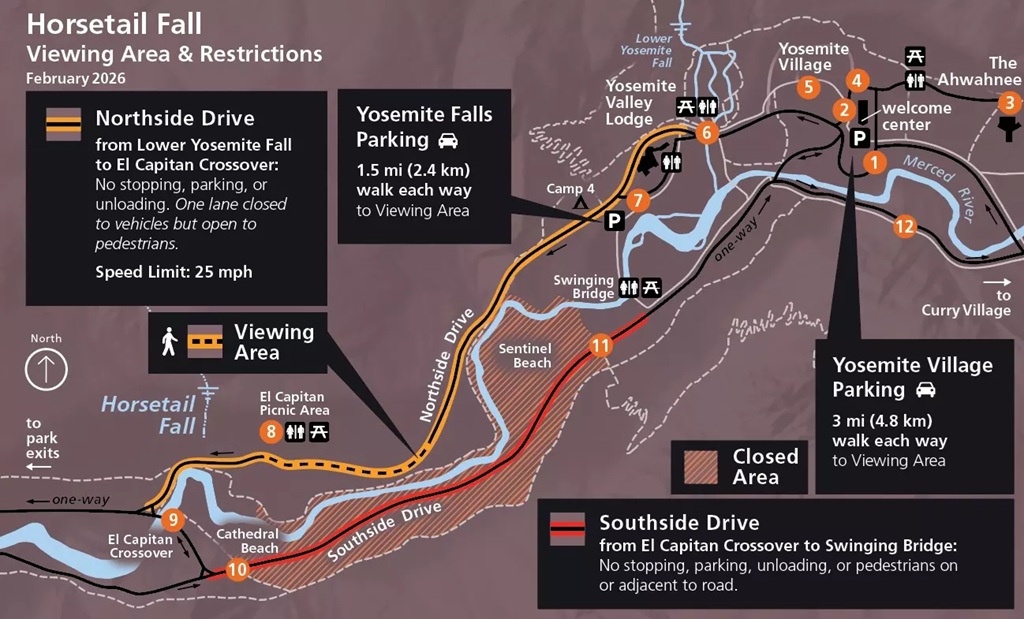
The closest parking to Horsetail Fall is the Yosemite Falls Parking Area, located just west of Yosemite Valley Lodge. From here, it’s about a 1.5-mile walk one-way to the official viewing area at El Capitan Picnic Area.
If this lot is full, park at Yosemite Village or Curry Village instead. Both locations offer free shuttle service, with extra shuttles running between Yosemite Village and Yosemite Falls parking.
Shuttle stop #7 at Yosemite Falls Parking/Yosemite Valley Lodge is the closest stop to Horsetail Fall. Then from there you must walk about 1.5 miles to the main viewing area.
⛔ Yosemite Firefall Viewing Area and Northside Drive Restrictions:
- Northside Drive will have one lane closed to vehicles so people can safely walk on the road between Yosemite Falls parking and the viewing area.
- Parking, stopping, or unloading passengers is not allowed between Lower Yosemite Fall and El Capitan Crossover.
- Visitors with a disability placard may drive to El Capitan Picnic Area and park in designated turnouts along Northside Drive.
🙅♀️ Southside Drive Restrictions:
- Southside Drive will remain open to vehicles, but stopping, parking, and unloading are prohibited between El Capitan Crossover and Swinging Bridge Picnic Area.
- People are not allowed to walk on or next to the road in this area.
- Between Cathedral Beach Picnic Area and Sentinel Beach Picnic Area, the area between the road and the Merced River is closed to all entry due to previous environmental damage.
Be prepared for delays and traffic congestion once Firefall is over! Please have patience.
🗺️ Yosemite Firefall Map
☃️ Yosemite in February
February is one of the best times to visit Yosemite! That said, winter weather can be unpredictable, so it’s important to be prepared. Here’s what to expect in February and how to make your trip as stress-free as possible.
🌨️ Yosemite Winter Weather:
Winter runs from December through March, but snow can fall as early as October or as late as April. Yosemite Valley is milder than the high country. Daytime highs in January and February are usually in the upper 40s°F (~9°C), with overnight lows in the upper 20s°F (~-2°C).
Snowfall in Yosemite Valley varies widely, averaging 30–40 inches, while surrounding peaks almost always have snow. Trails that climb above the valley floor can stay snowy even when the valley is clear.
Always check the weather forecast before your trip or during in case things change!
🛣️ Winter Road Conditions and Chains:
Some roads close for winter, including Tioga Road, Glacier Point Road, and Mariposa Grove Road. Open roads can still be icy, so drive slowly! Also, check current conditions online and call 209-372-0200 (press 1, then 1) for current road conditions.
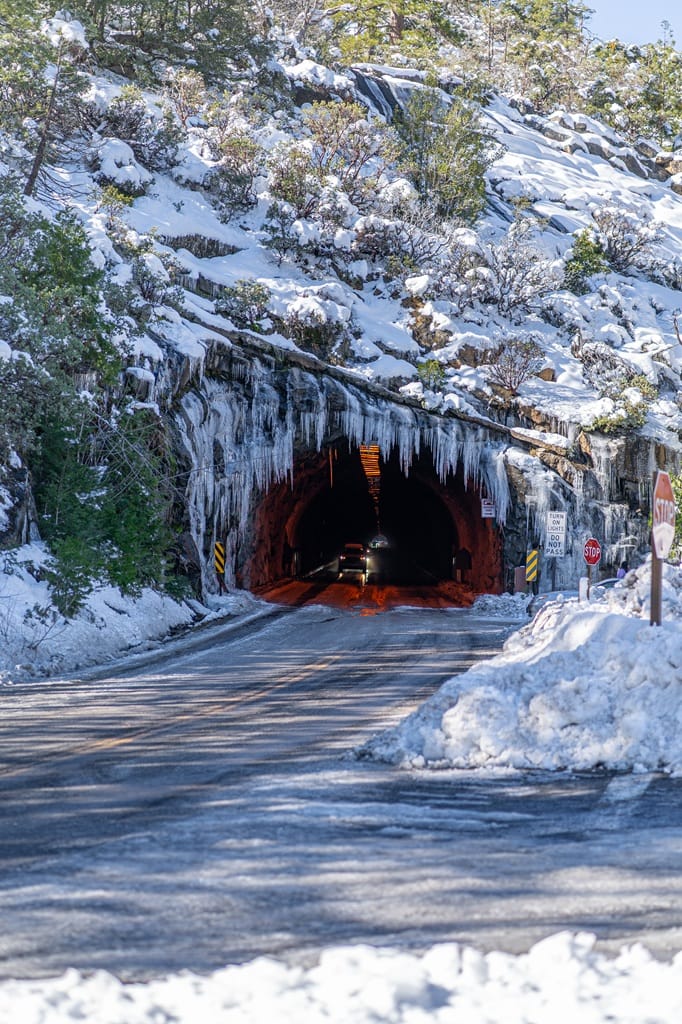
⛓️ Tire chains may be required at any time! Levels of control:
- R1 – You’ll need to put chains on your car unless you’re in a car, pickup, or SUV under 6,000 pounds AND you have snow tires with at least 6/32 inches of tread or deeper.
- R2 – You’ll need to put chains on your car unless you’re in a car, pickup truck, or SUV under 6,500 pounds AND you have snow tires with at least 6/32 inches of tread or deeper AND your car has 4WD or AWD engaged.
- R3 – Chains are required on ALL vehicles, no exceptions.
🚙 Yosemite Winter Travel Tips:
- Expect slower travel due to icy and snowy roads.
- Bring or purchase tire chains and make sure you know how to put them on.
- Pack plenty of layers, as temperatures can drop quickly.
- Keep in mind that daylight hours are shorter during winter.
- Plan for traffic congestion and limited parking during Firefall event (mid to late February) and Presidents’ Day weekend (February 14-16).
- Always carry emergency supplies in your car, including water, snacks, blankets, and flashlights, in case of breakdowns or unexpected snowstorms.
- The Yosemite Valley Shuttle System runs year-round and is a great way to get around the valley during winter, helping keep your visit hassle-free and stress-free.
❄️ Yosemite Winter Guides
- Ultimate Guide to Visiting Yosemite in Winter
- The Only Yosemite Winter Itinerary You Need!
- Where to Stay in Yosemite in Winter: 15+ Best Lodges, Hotels, and Cozy Cabins
- The Ultimate Yosemite Winter Packing List
- 20 Best Yosemite Hikes in Winter (Guide to Snowy Adventures)
- 18 Best Yosemite Winter Activities You Can’t Miss!
- Yosemite Firefall: A Complete First-Timer’s Guide
- Beginner’s Guide to Visiting Mariposa Grove in Winter
Yosemite Firefall History
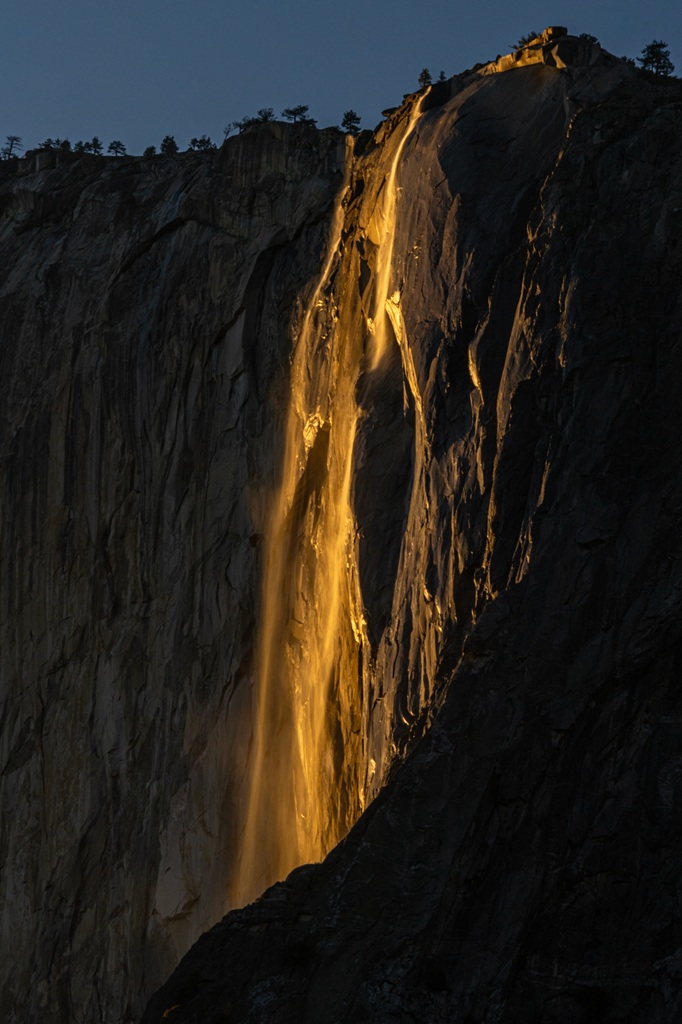
The name “Firefall” originally referred to a man-made spectacle at Glacier Point, not Horsetail Fall glowing from the setting sun. The man-made event predates the discovery of the natural event!
Back in 1872, James McCauley, owner of the long-gone Mountain House Hotel, started pushing burning bonfires off the cliff at Glacier Point. The glowing embers tumbled down 1,400 feet, creating what looked like a fiery waterfall for spectators in the valley below.
The show quickly became a hit, and by the early 1900s, thousands of visitors came to watch Firefall. David Curry of Camp Curry later formalized the event with a “fire master” directing the bonfires at exactly 9 PM each evening, using red fir bark for the best embers.
The Glacier Point Firefall continued until January 25, 1968, when the National Park Service ended it. Officials said it didn’t fit with Yosemite’s mission to protect natural resources, plus visitors trampled meadows, it created fire hazards, and the event required huge amounts of wood.
Fast forward a few years to 1973, photographer Galen Rowell stumbled across a new Firefall phenomenon but this time it was all natural. While driving along Southside Drive, he saw Horsetail Fall glowing in the setting sun like molten lava. He snapped a photo, creating the first widely-circulated image of the modern natural Firefall.
Today, the National Park Service does not officially call Horsetail Fall “Firefall.” They save that term for the historic Glacier Point bonfire event. However, everyone else calls the modern natural phenomenon Firefall anyway.
So, when you see the orange glow on Horsetail Fall in February, you’re enjoying a totally natural show that’s a lot safer and environmentally friendly as compared to the historic human-made tradition. How cool is that!?
Best Time to See Yosemite Firefall
The best time to see Firefall in Yosemite is sometime in mid to late February. For this year, 2026, most people are saying that the window is February 10-28 with peak time between February 18-23.
It occurs about 5 to 15 minutes before sunset. Make sure you know what time the sun sets on the day you plan to go! The sunset time changes every day just by a little.
🌄 Check timeanddate.com to know exactly when the sun sets in Yosemite Valley!
If you’re casually viewing Firefall for fun, plan to arrive 1 to 2 hours beforehand (maybe a bit earlier on weekends) to secure a decent spot. If you’re a professional photographer wanting that perfect shot and you’re visiting on a weekend, plan to get to the viewing area EARLY, like 4+ hours beforehand.
And, if possible, staying several nights in or outside Yosemite will give you a better chance of seeing Horsetail Fall glow in the right conditions.
Best Place to See Yosemite Firefall
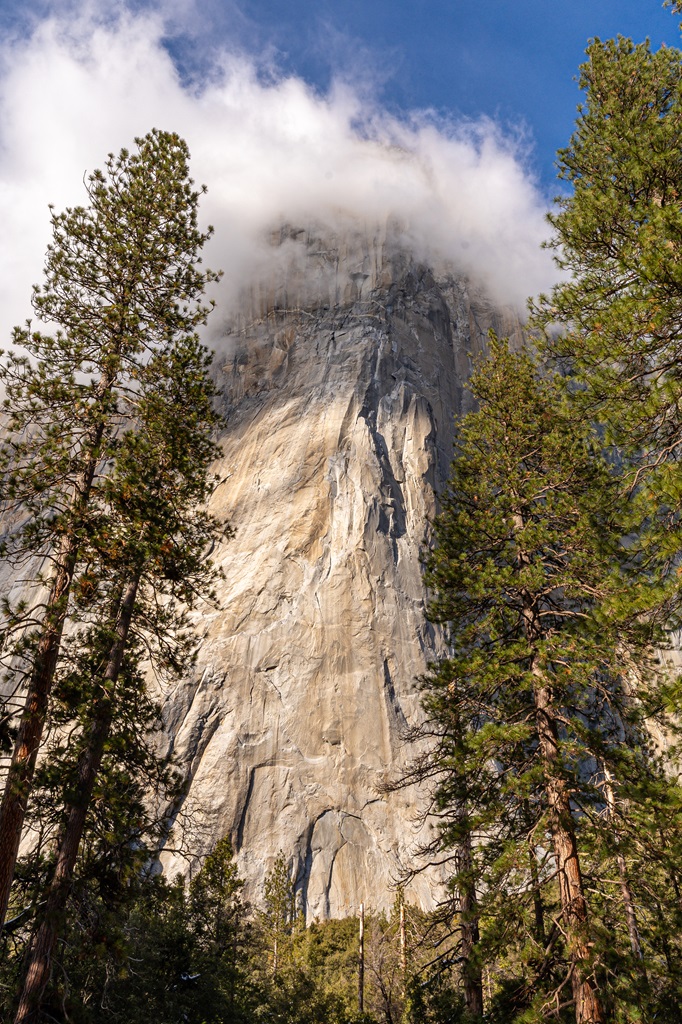
There is now only one main area to watch Firefall in Yosemite – El Capitan Picnic Area.
Due to environmental damage from previous years, the park service has restricted access to areas along Southside Drive between the Swinging Bridge Picnic Area and Cathedral Beach near the El Capitan Crossover.
There are other spots to view Firefall from high above the valley floor but it requires hiking along steep trails and sometimes off trail scrambling which can be dangerous, especially during the winter months so I won’t be discussing those options here.
✅ The El Capitan Picnic Area is the best and most accessible spot to watch Firefall!
- The area is wide and open, able to accommodate hundreds of visitors and photographers, and it’s easy to access from nearby parking.
- Vault toilets, trash, and recycling dumpsters are available for convenience.
- Again, get there early to secure a good parking spot AND a good Firefall-watching spot.
Yosemite Firefall Tips
1. Plan for Winter Conditions: February can bring snow and ice. Roads may be slick so carry tire chains (required by law), even if you have AWD/4WD. Call 209-372-0200 (press 1, then 1 again) for current road conditions.
2. Arrive Early: Parking and good viewing spots fill quickly. Make sure to arrive several hours before sunset. Bring a chair, a book to read, snacks, and a warm drink so you can wait comfortably.
3. Use the Shuttle if Needed: The free Yosemite Valley Shuttle runs until 10 PM and helps you avoid parking stress, especially on busy weekends.
4. Check Yosemite Falls Webcam: Use the Yosemite Falls webcam to see how much water is flowing. This will give you an idea if Horsetail Fall is flowing as well.
5. Know the Sunset Time: Make sure you check the sunset time for the day you are visiting. Horsetail Fall lights up about 5 to 15 minutes before the sun sets.
6. Dress Warm and Prepare to Walk in the Dark: Bring layers, warm footwear, traction devices (if snow/ice is present), and a headlamp or flashlight for the walk back to your car.
7. Prepare for a Decent Amount of Walking: Plan to walk at least 3 miles roundtrip from the Yosemite Falls Parking Area to the viewing area at El Capitan Picnic Area and back to your car. If you are parked further away, you can take the shuttle to the Yosemite Falls Parking stop #7 then walk 1.5 miles one-way to the main viewing area.
8. Follow Leave No Trace: Stay out of meadows and fenced areas! These areas are fragile and support native plants and wildlife. Also, plan ahead, pack out all trash, avoid disturbing wildlife, be considerate of others, and respect the natural beauty of Yosemite National Park.
9. Be Bear Aware: Keep food stored properly, never feed wildlife, keep your distance, and follow these bear safety guidelines. Also, bear spray is prohibited in Yosemite!
10. Have Patience and Kindness: It will likely be very crowded during Firefall. Have patience and be kind to fellow visitors and photographers. They’re all there to witness the same magical spectacle as you! 🫶
FAQs: Yosemite Firefall 2026
-
What is the best time to see the Firefall at Yosemite?
The best time to see Firefall at Yosemite is mid to late February. If you’re able, go on a weekday and avoid Presidents’ Day weekend! The crowds will be insane during that holiday weekend.
-
Can you see the Firefall every year?
Firefall is an annual event and it’s possible to see it every year only if conditions are right.
-
How often does Firefall happen in Yosemite?
Firefall happens every year for about 2 weeks in mid to late February. It occurs daily at sunset during this 2-week window.
-
How long does the Yosemite Firefall last?
It lasts about 5 to 15 minutes before sunset.
-
What causes the Yosemite Firefall?
Firefall occurs when the setting sun hits Horsetail Fall at just the right angle, making the water glow like it’s on fire. The effect depends on several factors, like having enough snowmelt, clear skies, and perfect sun alignment.
-
How crowded does Yosemite get during Firefall?
Yosemite during the Firefall event gets very crowded, especially on weekends and Presidents’ Day weekend. It’s the busiest time during all the winter months.
-
Are reservations needed to see Firefall?
No, reservations are not needed to see Yosemite’s Firefall in 2026.
-
Is Firefall in Yosemite worth seeing?
Yes, Firefall in Yosemite is worth seeing! You’ll get to experience an amazing natural spectacle and also enjoy a full day of hiking and exploring Yosemite Valley.
Where to Stay in Yosemite During Firefall
Staying in Yosemite Valley in February during the Firefall event is the best and most convenient choice! But lodging in the valley is limited and rooms book up far in advance.
To snag a room inside the valley at any of the lodges, plan to book as far in advance as possible. Reservations are open 366 days ahead! If you’re flexible, you can try to get last-minute cancellations, especially at campgrounds if you don’t mind roughing it in the cold winter weather.
If you are unable to book a place in the valley, don’t worry! There are plenty of options just outside of the park. Just be prepared for a bit more driving.
🏨 Lodging in Yosemite Valley in February
Yosemite Valley Lodge
- Location: Yosemite Valley, about 2 miles from the El Capitan Picnic Area
- Price: Midrange ($$)
- Top Amenities: On-site restaurants, walking distance to popular trails, and some rooms have a view of Yosemite Falls
- Lodging Options: 245 rooms, including traditional, family, bunk, and ADA-accessible options
Yosemite Valley Lodge is a favorite for its central location, affordable rates, and easy access to iconic sights and trails. It’s also the best place to stay during Firefall!
Trails nearby include Lower Yosemite Fall Trail, Cook’s Meadow Loop, Upper Yosemite Fall Trail, and Valley Loop Trail.
There are also several on-site dining options, such as The Mountain Room Restaurant and Lounge, Base Camp Eatery, and Starbucks.
🤩 Book your stay at Yosemite Valley Lodge
The Ahwahnee
- Location: Yosemite Valley, about 3.8 miles from the El Capitan Picnic Area
- Price: Luxury ($$$–$$$$)
- Top Amenities: Dining room and bar, heated outdoor pool, shuttle access, gift shop, valet parking, EV charging, and concierge
- Lodging Options: Standard hotel rooms, premmuim suites with fireplaces or balconies, and cozy cottages for more privacy
The Ahwahnee is Yosemite’s most iconic lodge, combining grand 1920s architecture with cozy wood-and-stone charm. As a National Historic Landmark, it’s hosted presidents, royalty, and luxury travelers for decades.
Inside, you’ll find soaring ceilings, massive stone fireplaces, and historic artwork that make the hotel feel like stepping into Yosemite’s past. For a luxurious, historic stay right in the heart of Yosemite Valley, The Ahwahnee is hard to beat.
🤩 Book your stay at The Ahwahnee
Curry Village
- Location: Yosemite Valley, about 4 miles from the El Capitan Picnic Area
- Price: Budget to midrange ($–$$)
- Top Amenities: On-site dining, nearby trails, outdoor ice skating rink (winter only)
- Lodging Options: Heated and unheated canvas tent cabins, wood cabins, and standard hotel rooms
Curry Village has welcomed guests since 1899 and remains a historic and popular spot. Lodging can sell out quickly, especially during winter holidays and Firefall, so book early!
All tent cabins come with bear-proof lockers for food, toiletries, and scented items.
Food is easy with several on-site options, including Pizza Deck, Seven Tents Pavilion, Bar 1899, Coffee Corner, and Taqueria @ The Meadow Grill.
Don’t miss out on ice skating at the outdoor rink. Tickets are available online or in person. It’s a classic Yosemite winter experience!
🤩 Book your stay at Curry Village
🏕️ Campgrounds in Yosemite Valley in February
During winter, two campgrounds remain open in Yosemite Valley:
- Upper Pines (Yosemite Valley)
- Camp 4 (Yosemite Valley)
During Firefall, these campgrounds fill up quickly so plan to book far in advance. There are two other campgrounds outside of the valley that may have more chances of availabilities. ⬇️
- Hodgdon Meadow Campground (near Big Oak Flat Entrance, 45 minutes northwest of Yosemite Valley)
- Wawona Campground (near Wawona, 45 minutes south of Yosemite Valley)
🏨 Lodging Outside Yosemite in February
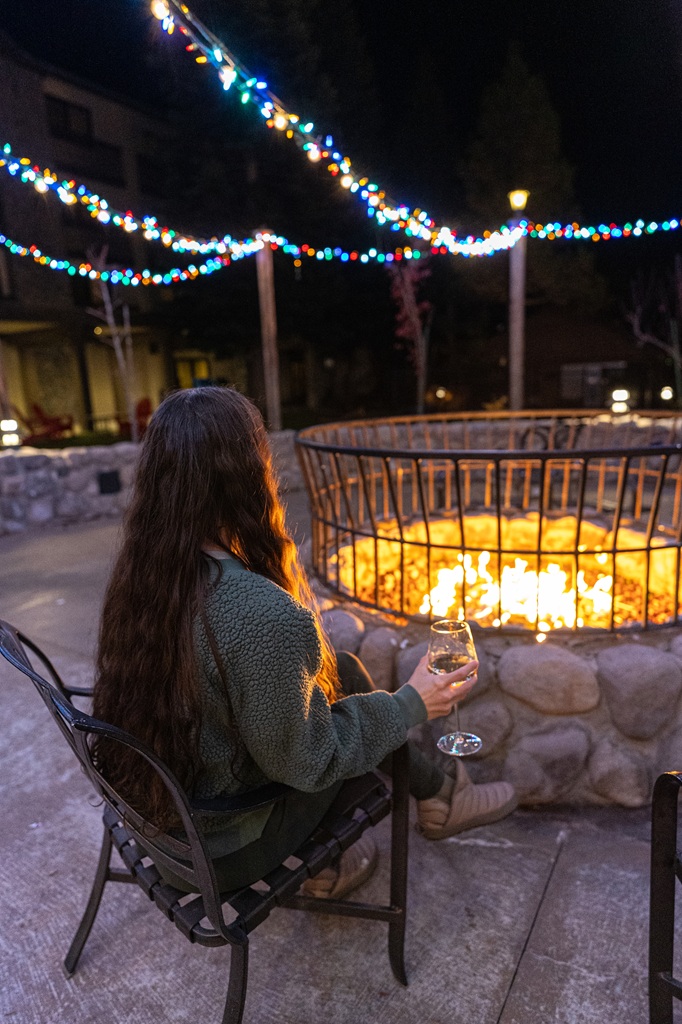
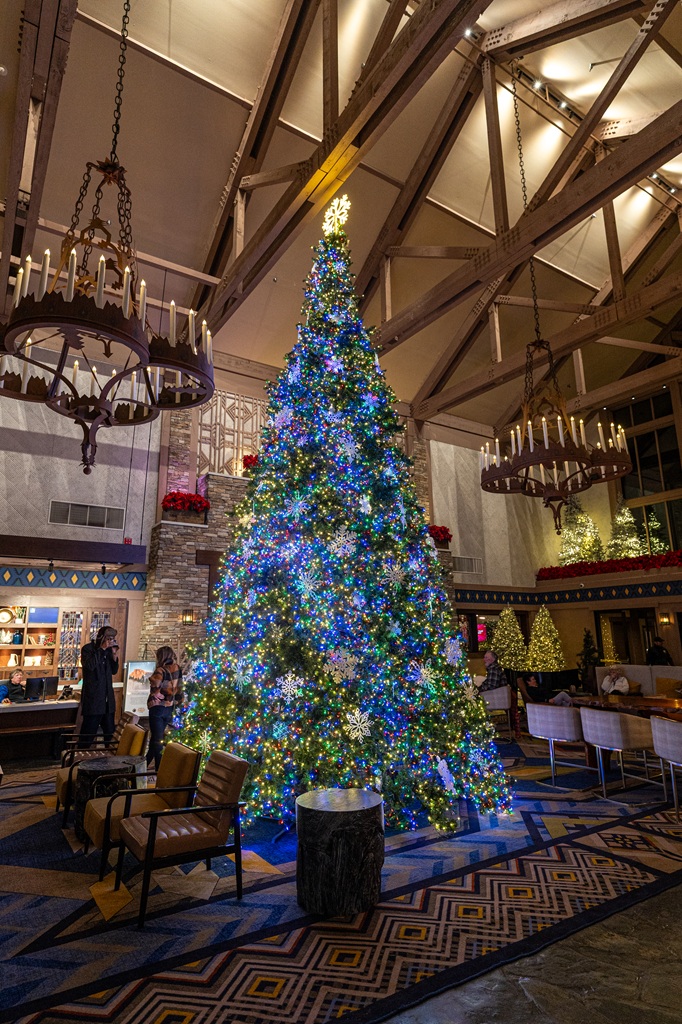
Tenaya Lodge (Tenaya at Yosemite)
- Location: Fish Camp, 5 minutes from Yosemite’s South Entrance
- Price: Midrange to luxury ($$–$$$)
- Top Amenities: Ascent Spa, indoor pool, hot tubs, s’mores station, on-site dining, game room, year-round activities (archery, mountain biking, guided hikes, and more) as well as winter activities (ice skating, snowshoeing, and sledding)
- Lodging Options: Explorer Cabins, Cottages, and standard rooms and suites at the main lodge
👉 Is staying at Tenaya Lodge worth it? Read my honest, in-depth Tenaya Lodge review!
Tenaya Lodge is perfect for those wanting to visit Yosemite in February but looking to combine time out in nature with a luxurious experience.
You will have access to lots of complimentary activities and delicious restaurants on-site, including Jackalope’s Bar & Grill, Timberloft Pizzeria, Embers, and Parkside Deli.
With all the activities, restaurants, and special events, you could literally have a fun-filled vacation by just staying at Tenaya Lodge. But Firefall in Yosemite is calling, so don’t forget the main reason you traveled all this way!
🤩 Book your stay at Tenaya Lodge
Best Western Plus Yosemite Gateway Inn
- Location: Oakhurst, 25 minutes from Yosemite’s South Entrance
- Price: Budget to midrange ($–$$)
- Top Amenities: Free breakfast, indoor pool, fitness center, playground, laundry facilities, and on-site dining
- Lodging Options: Standard hotel rooms and suites
For a nice and affordable stay near Yosemite’s South Entrance, Best Western Plus Yosemite Gateway Inn is a solid choice. Reviews rave about their clean rooms, friendly staff, and resort-style layout with multiple buildings and peaceful gardens.
The hotel has a full-service restaurant, Oakhurst Grill & Whiskey 41 Lounge, serving breakfast, lunch, and dinner. If you want comfort, convenience, and value near Yosemite without breaking the bank, this is a great option.
🤩 Book your stay at Best Western Plus Yosemite Gateway Inn
Yosemite View Lodge
- Location: El Portal, 5 minutes from Yosemite’s Arch Rock Entrance
- Price: Midrange ($$)
- Top Amenities: Kitchenettes, indoor heated pool, hot tubs, pet-friendly rooms, fire pits, convenience store, and on-site dining
- Lodging Options: Standard hotel rooms (some fireplaces or spa tubs) and one or two-bedroom suites
Yosemite View Lodge is the closest hotel to Yosemite’s Arch Rock Entrance, making it perfect for easy access to Yosemite Valley during Firefall. Read my complete Yosemite View Lodge guide and review before you book!
The property sits along the Merced River with some rooms offering river or mountain views. On-site restaurants include The River Restaurant & Lounge and Parkside Pizza.
For simple, convenient lodging just minutes from the park, Yosemite View Lodge is a great choice!
🤩 Book your stay at Yosemite View Lodge
Yosemite Cedar Lodge
- Location: El Portal, 15 minutes from Yosemite’s Arch Rock Entrance
- Price: Budget to midrange ($–$$)
- Top Amenities: Private river beach, indoor pool, hot tubs, free breakfast, on-site restaurants, gift shop, and YART bus stop right outside the lobby
- Lodging Options: Standard hotel rooms and suites
Yosemite Cedar Lodge is a comfortable, budget-friendly option just 8 miles from the Arch Rock Entrance, making it perfect for a quick and easy winter visit.
On-site dining includes the Cedar Lodge Restaurant (unfortunately it’s closed during the off-season) and Canyon Bar & Grill (I believe this one remains one year-round but not entirely sure).
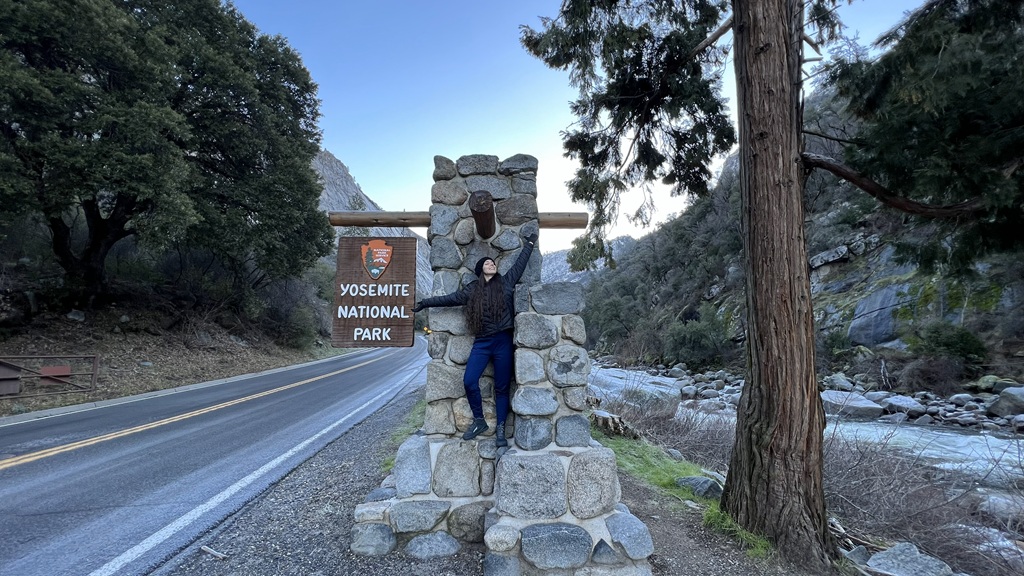
My husband and I have stayed here before in January 2023 and enjoyed the lodge. Our favorite part was the river beach area! It was really nice to relax over there after a long day in the park.
🤩 Book your stay at Yosemite Cedar Lodge
AutoCamp Yosemite
- Location: Midpines, 40 minutes from Yosemite’s Arch Rock Entrance
- Price: Midrange to expensive ($$-$$$)
- Top Amenities: Clubhouse, general store, fire pits, on-site dining, private bathrooms in most units, seasonal outdoor pool, bike rentals, grilling areas, and WiFi
- Lodging Options: Airstream suites, premium and accessible cabins, family cabins, BaseCamps (includes both an airstream and a canvas tent), and Adventure Tents
AutoCamp Yosemite offers a scenic and fun glamping experience. In winter, the Clubhouse offers warm drinks and an indoor fire pit for a relaxing evening.
On-site dining includes The Kitchen which serves breakfast, lunch, and dinner. They also have a general store stocked with trail snacks, local beer and wine, s’mores kits, grill kits, and grab-and-go items.
It’s the perfect place where you can spend the day exploring Yosemite and then come home to a cozy fire, good food, and a comfy bed.
🤩 Book your stay at AutoCamp Yosemite
Rush Creek Lodge
- Location: Groveland, 5 minutes from Yosemite’s Big Oak Flat Entrance
- Price: Midrange to expensive ($$–$$$)
- Top Amenities: Spa, heated outdoor pool, hot tubs, playground, on-site restaurant, general store, fire pits, and on-site activities (bike rentals, giant checkers, ping pong, and guided winter adventures)
- Lodging Options: Standard hotel rooms, suites, and villas
Rush Creek Lodge is the perfect place to stay if you want a mixture of outdoorsy vibes and modern comforts.
The Restaurant at Rush Creek serves delicious meals for breakfast and dinner, and Rush Creek Tavern is open for lunch and dinner offering a more casual atmosphere. You can also stop by the general store for coffee, snacks, and souvenirs.
The lodge is a certified B Corp, with eco-friendly initiatives and a youth employment program, so your stay supports sustainability and the local community.
🤩 Book your stay at Rush Creek Lodge
Evergreen Lodge
- Location: Groveland, 5 minutes from Hetch Hetchy Entrance, 20 minutes from Big Oak Flat Entrance
- Price: Midrange to expensive ($$–$$$)
- Top Amenities: Heated pool, hot tub, game room, on-site restaurant and bar, general store, and outdoor activities
- Lodging Options: Cabins and glamping tents
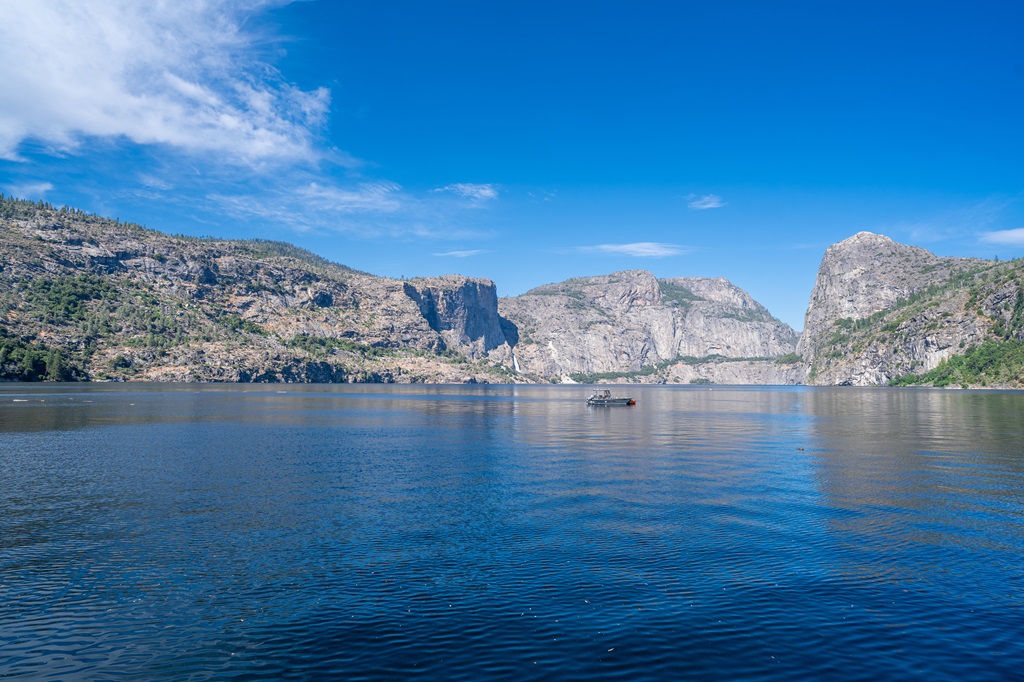
Evergreen Lodge is a relaxing, woodsy retreat tucked into the forest near Yosemite’s Hetch Hetchy Entrance.
The lodge is full of fun amenities, including ping pong, billiards, nightly activities, a heated pool, hot tub, and a playground. Plus, there’s an on-site restaurant and general store for meals and essentials.
As a founding B Corp, Evergreen Lodge focuses on social and environmental initiatives. After exploring Yosemite, unwind with a massage in a private cabana or at the nearby indoor/outdoor spa at Rush Creek Lodge.
🤩 Book your stay at Evergreen Lodge
Yosemite Westgate Lodge
- Location: Groveland, 20 minutes from Yosemite’s Big Oak Flat Entrance
- Price: Budget to midrange ($–$$)
- Top Amenities: Hot tub, playground, on-site dining, spacious rooms
- Lodging Options: Standard hotel rooms
Yosemite Westgate Lodge offers clean, roomy accommodations with a flat-screen TV, fridge, microwave, and coffee maker.
On-site amenities include a seasonal pool, hot tub, and playground, plus the Lucky Buck Cafe serving breakfast, lunch, and dinner. Groveland is nearby for additional dining and shopping.
It’s a simple and affordable place to stay during the Firefall even in Yosemite.
🤩 Book your stay at Yosemite Westgate Lodge
✨ Need more options when finding the perfect place to stay near Yosemite?
Don’t worry, I got you covered! I created an ultimate guide to help you find a place to stay when visiting Yosemite National Park. I’ve broken everything down by town, organized by the park entrance they’re closest to.
From there, I list different types of accommodations, including hotels, resorts, B&Bs, vacation rentals, campgrounds, and RV parks. Click the button below and explore top-rated places to stay outside of Yosemite, based on your travel style, budget, and the parts of the park you plan to visit!
Yosemite Firefall Packing List
The big list below is a general packing list for visiting Yosemite in winter. A few things not listed that you might want when planning to see Firefall ⬇️
- Camping chair
- Hand warmers
- Binoculars
- Warm drink in an insulated bottle
- Blanket
You might be waiting around for a few hours so pop a squat in your chair and relax while you wait for the magic to happen! Also, I’m not a photographer. I do take pictures and I try to take nice pictures for this blog, but I am by no means a professional.
📸 Here’s what I personally bring to take Firefall pictures:
- Sony Alpha 7C Camera
- 70-200mm lens (I use this one all the time) or 100-400mm lens (this lens has been recommended but I don’t own one of these)
- Tripod (on our first trip to see Firefall in 2025, I didn’t use a tripod… but it’s highly recommended)
- SanDisk memory card
- Power bank and charger for your camera
- Camera backpack to safely hold all your electronics
Firefall occurs at sunset, so what are you plans during the day? If you’re hitting some trails and exploring all the beautiful sites in Yosemite Valley, this list has everything you need! 👇
🎒 Backpack – A pack around 22–30 liter works well to carry layers, snacks, water, and gear. I’ve been using the Cotopaxi Luzon Del Dia 24L Pack and my husband uses the REI Co-op Trail 25L Pack.
🥾 Winter Boots – Waterproof, insulated boots are a must!
🧊 Microspikes – Bring a pair of microspikes if you’re visiting in the winter and you’re planning to hike along icy trails. They will give you good traction to avoid slipping! I use Black Diamond Access Spike Traction Device.
❄️ Snowshoes – Best used when hiking on deep, soft, or loose snow, usually anything over six inches, to prevent sinking, also known as postholing. Don’t own any? You can rent them at the Badger Pass Ski Area!
☃️ Gaiters – Keep snow out of your boots when snowshoeing or hiking in deep snow.
🥢 Trekking Poles – Essential for stability on snow and slippery trails. I use REI Co-op Trailmade Trekking Poles and love them!
🧥 Warm Layers (top) – Pack a moisture-wicking base layer, a fleece mid-layer, an insulated jacket, and an outer shell to protect you from the elements, such as rain, snow, and wind. Check out my favorite tops 👇
- Base layer: REI Co-op Midweight Long-Sleeve Base Layer
- Fleece mid layer: Cotopaxi Teca Fleece Full-Zip Jacket
- Down mid layer: Cotopaxi Fuego Hooded Down Jacket
- Outer shell: Patagonia Torrentshell 3L Jacket
👖 Warm Layers (bottom) – Pack a breathable base layer, fleece-lined mid-layer, and soft-shell pants. A pair of hard-shell pants might be overkill but depends on the conditions and the winter adventure you plan to go on. My favorite fleece bottoms are the Baleaf Fleece Jogger Pants and the Baleaf Fleece Leggings.
🤠 Warm Hat/Beanie – Keeps your head and ears warm on cold winter hikes. My favorite beanie is the Cotopaxi Tozo Beanie!
🧦 Socks – Moisture-wicking, quick-drying socks are the way to go. My favorite pair of hiking socks are Darn Tough Hiker Micro Crew Cushion Socks. I’m obsessed with them!
🥶 Emergency Shelter – Pack an emergency bivy sack or space blanket for shelter in case of sudden weather changes.
🗺️ Navigation – Carry a physical topographic map, compass, a satellite messenger (or personal locator beacon), and download offline maps to help you stay on course, find your way in unfamiliar terrain, and call for help if needed.
🔦 Headlamp/Flashlight – A reliable light source with extra batteries, in case you end up hiking in the dark or need it for emergency situations.
🩹 First-Aid Kit – A basic first-aid kit with items like bandages, antiseptic, pain relievers, and any personal medications you may need.
💧 Water – Water bottles to carry sufficient water to stay hydrated, along with a filtration system or purification tablets if you plan to refill from natural sources.
🍕 Food – Energy-rich snacks or meals to keep your energy levels up during the hike.
😎 Sun Protection – Sunscreen, sunglasses, and a sunhat to protect yourself from harmful UV rays, even when it’s cloudy. Also, polarized sunglasses are important when it’s bright outside and the ground is covered in snow/ice.
🔥 Fire – A lighter, matches, or fire starter to help you build a fire for warmth or signaling in case of emergency. Along with matches, I also carry a multi-tool carabiner that has a fire starter, utility blade, screwdriver, and bottle opener.
🗡️ Multi-Tool and Repair Kit – A versatile tool/knife and repair kit to handle any task, from preparing food to making repairs.
🚙 Winter Car Kit – Pack a basic winter car kit in case you get caught in a snowstorm, including blankets or sleeping bags, extra warm layers, ice scraper, small shovel, extra water, snacks, flashlights, portable power bank with chargers, and signaling devices. And don’t forget tire chains!
✨ Need help figuring out exactly what to pack for Yosemite this winter? Read my complete Yosemite winter packing list and download the PDF checklist to make packing quick and easy!
Yosemite Firefall 1-Day Itinerary
If you’re not a professional photographer and don’t plan to find that one special spot to capture the perfect picture of Firefall and remain there all day long, then follow this itinerary for a fun day exploring Yosemite Valley!
Still plan to arrive to the viewing area maybe a few hours beforehand just to find a decent spot. It is less stressful when you’re not a photographer and just want to watch this incredible phenomenon.
🌄 Sunrise at Tunnel View
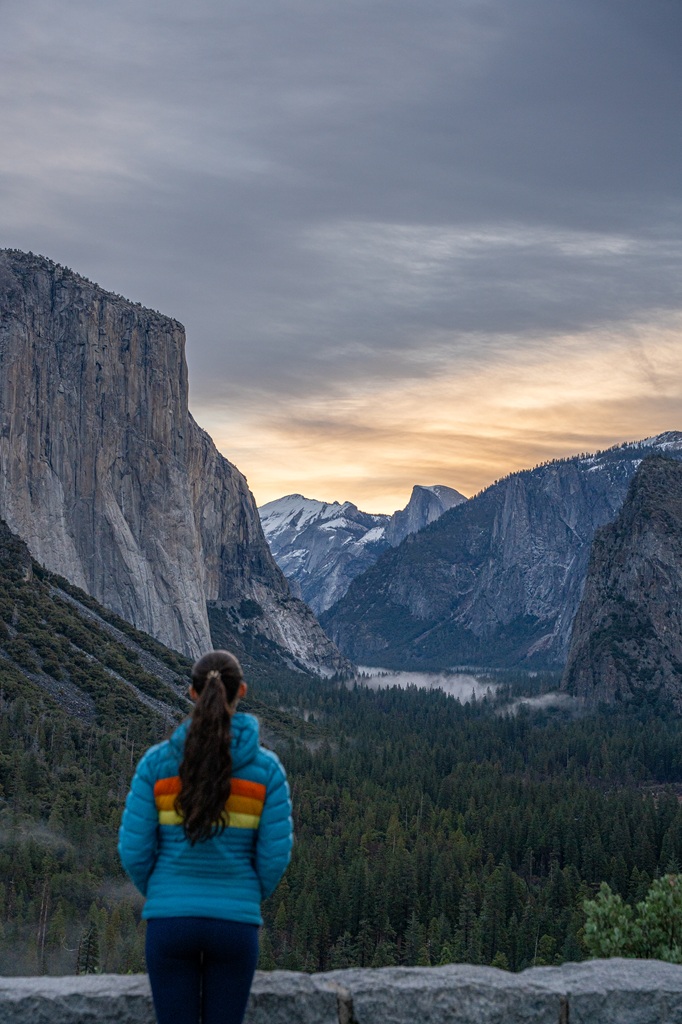
If you’re an early riser, start your day by watching the sunrise at Tunnel View! From this classic viewpoint, you’ll see El Capitan, Half Dome, Bridalveil Fall, Clouds Rest, Sentinel Rock, and the Cathedral Rocks.
In winter, it’s especially magical when the valley floor and granite cliffs are dusted with snow.
If you’re entering from the South Entrance on Highway 41, you’ll drive through the Wawona Tunnel, the longest highway tunnel in California, right before the view opens up.
Just make sure to check the exact sunrise time before you go, since it changes daily.
💧 See Bridalveil Fall Up Close
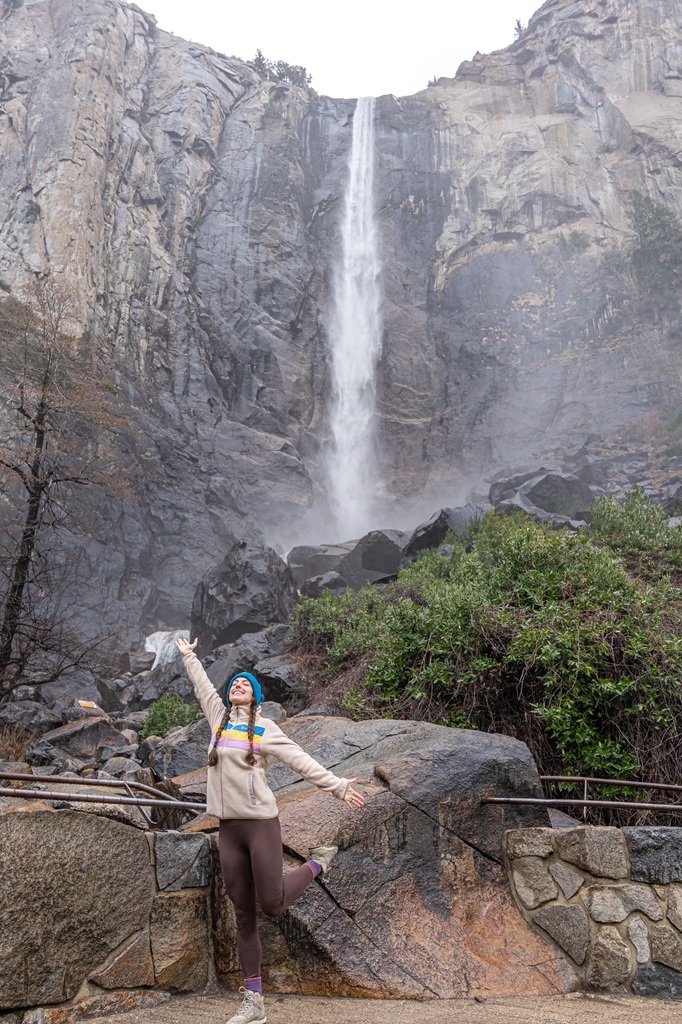
Right down the road from Tunnel View is the Bridalveil Fall parking area. Park here and walk just 0.25 miles to the base of the 620-foot waterfall known as Bridalveil Fall.
This waterfall can be seen from other viewpoints in Yosemite Valley, such as Tunnel View and Valley View.
Main parking lot holds about 60 cars. There is also roadside parking along Southside Drive.
There is no shuttle service to this area. Restrooms can be found at the main parking lot.
🌿 Explore Swinging Bridge and Cook’s Meadow
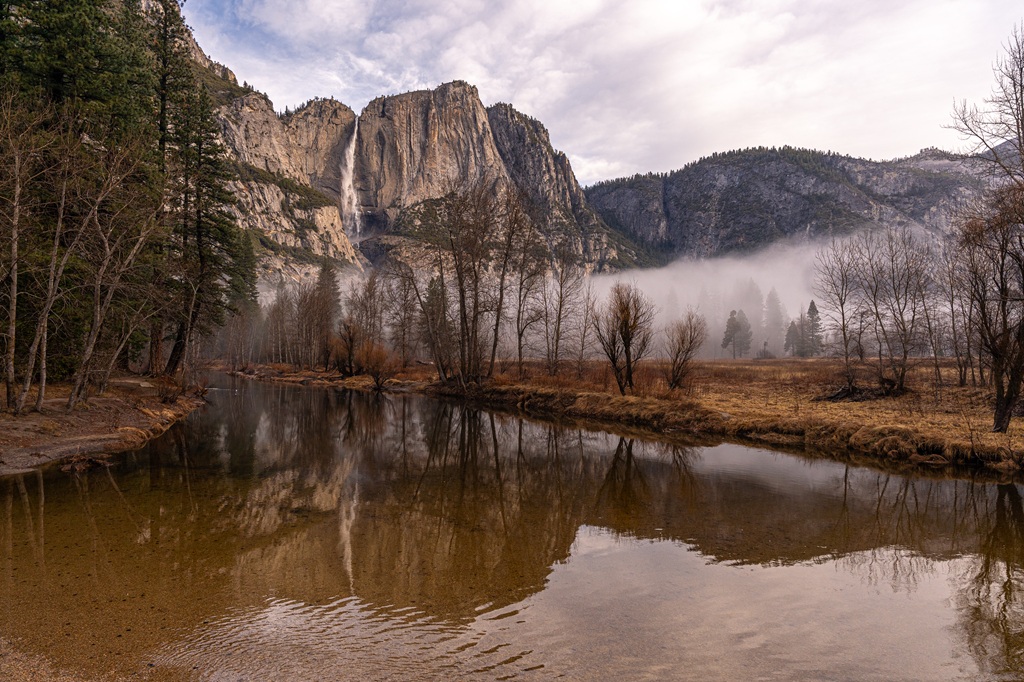
Swinging Bridge Picnic Area is a pretty riverside stop along the Merced River with picnic tables, vault toilets, and a paved walking/biking path.
From the bridge, you’ll get a great view of Yosemite Falls.
Parking is limited and fills fast. If the lot is full, continue down Southside Drive and use roadside parking, then walk the short paved path back to the picnic area.
One big perk of stopping here is how close you are to Cook’s Meadow!
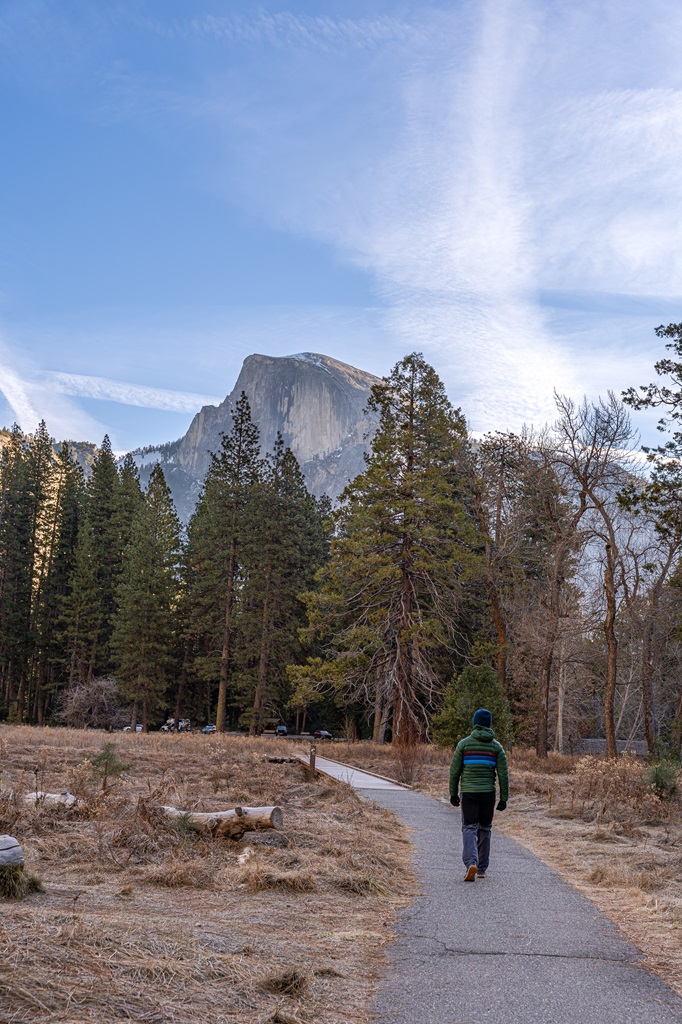
The Cook’s Meadow Loop is an easy 1-mile walk along a flat, family-friendly, and pet-friendly path.
You will get incredible views of Yosemite Falls, Half Dome, Glacier Point, and Sentinel Rock.
Along this route, stop by the Yosemite Valley Chapel, Sentinel Bridge, and Superintendent’s Bridge. They’re great photo spots!
Winter conditions can make the boardwalks icy so bring microspikes and hiking poles. And stay on marked trails to help protect the meadow.
Pair this trail with the Lower Yosemite Fall Trail for a scenic 2-mile loop!
🥾 Hike the Lower Yosemite Fall Trail
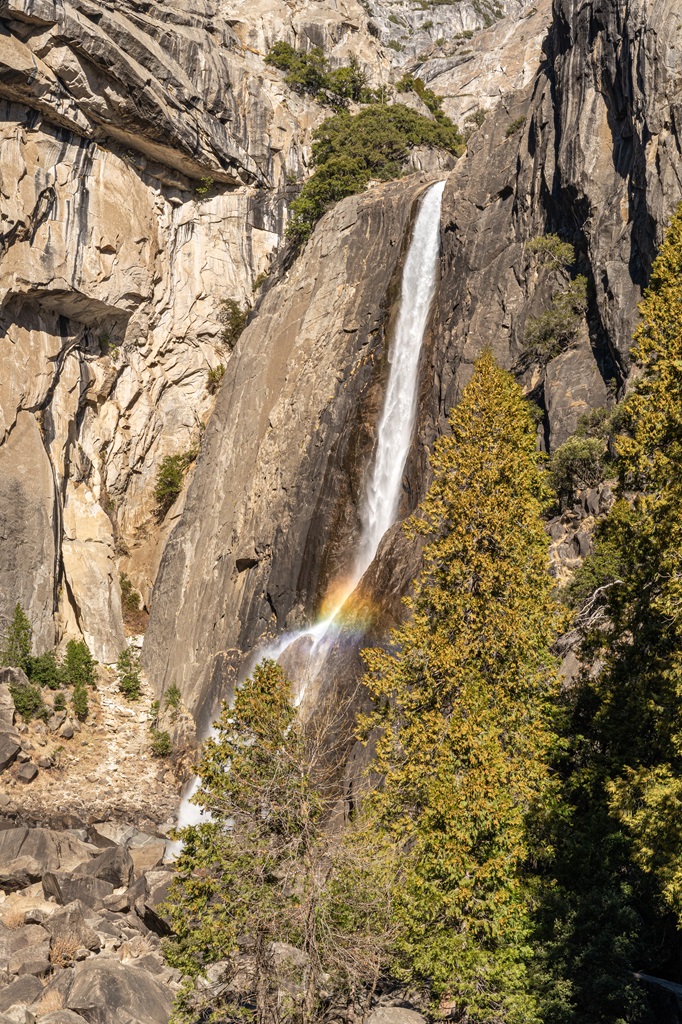
The Lower Yosemite Fall Trail takes you right to the base of the final 320-foot drop of Yosemite Falls, one of the tallest waterfalls in North America.
This easy 1.2-mile loop has several great viewpoints along the way. The west side of the loop is my favorite spot to see all three tiers at once!
Be cautious of icy spots in winter, especially near the footbridge. Also, there’s no parking at the trailhead.
You can park at Yosemite Village or Yosemite Falls parking area. The shuttle can also drop you off at stop #6 for easy access.
🥾 Hike to Mirror Lake
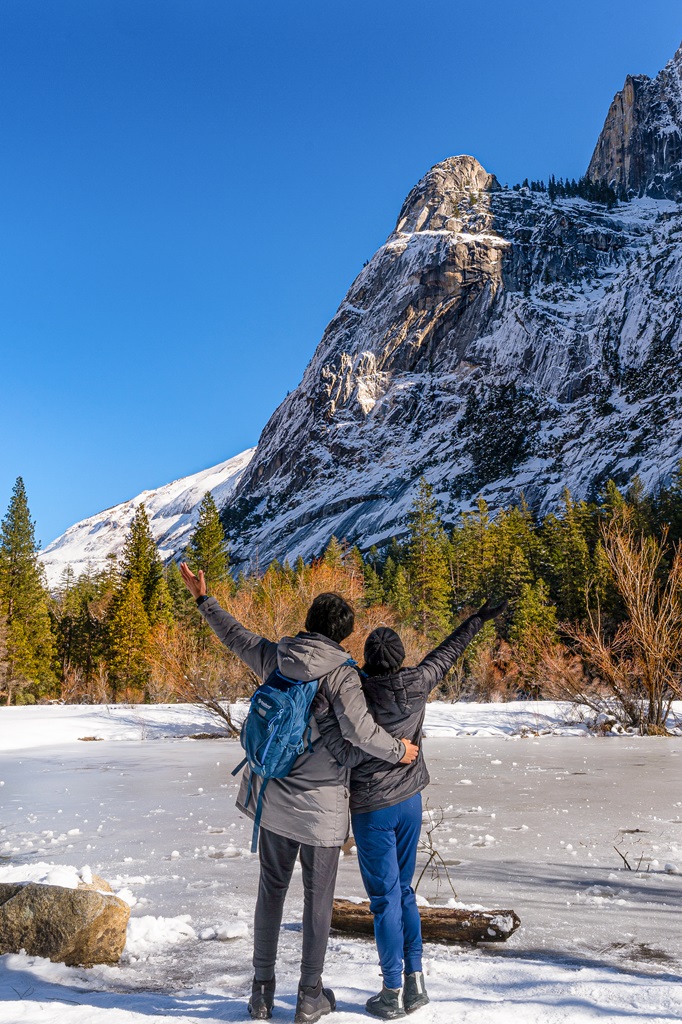
Mirror Lake is one of Yosemite Valley’s most scenic spots with views of Half Dome, Mount Watkins, and Washington Column.
In winter, the lake is usually frozen, but the snowy granite walls still make it a beautiful and peaceful place to visit.
The easiest way to get there is a 2-mile out-and-back walk along a paved road. It’s a great family-friendly hike. Just watch for icy patches!
There’s no parking at the trailhead, so park at Curry Village or Yosemite Valley Trailhead Parking, or take the shuttle to stop #17.
Vault toilets are available about halfway in and near the lake.
🖼️ Check Out The Ansel Adams Gallery and The Yosemite Museum
If you love photography or Yosemite history, The Ansel Adams Gallery in Yosemite Village is a must-stop. Founded in 1902, it’s a Registered Historic California Business. Ansel Adams himself lived and worked in the same building!
Inside, you’ll find a stunning collection of his original photographs, from early work to iconic Western landscapes, plus books, maps, handicrafts, and beautiful Native American jewelry.
The Yosemite Museum is a great place to learn about the cultural history of Yosemite’s Native peoples. Exhibits focus on the Miwok and Paiute tribes from the mid-1800s to today, with demonstrations like basket weaving, beadwork, stone tool making, and traditional games.
Out front, you can touch a giant sequoia cross-section and see a replica umacha (a traditional cedar-bark home). Behind the museum, an easy self-guided path leads through the reconstructed Indian Village of Ahwahnee.
🍔 Park at Yosemite Falls Lot and Eat a Meal at Yosemite Basecamp
Park at the Yosemite Falls Parking Area and stop by Base Camp Eatery for a meal before heading out to watch Firefall. It offers a mix of fresh, seasonal dishes, front-of-house cooking, and easy grab-and-go options. There’s also a Starbucks on-site!
If the parking lot happens to be full by the time you get there, park at Yosemite Village instead and take the shuttle. You can also eat at Degnan’s Kitchen which is located at the village.
🔥 Walk to the Firefall Viewing Area and Enjoy the Show
If you’re already parked at the Yosemites Falls lot, then start making your way to the Firefall viewing area located at the El Capitan Picnic Area.
If you are parked elsewhere, hop on the shuttle to stop #7 (Yosemite Falls parking) then walk to the viewing area.
Now relax and enjoy watching Horsetail Fall transform into what looks like molten lava flowing down the side of El Capitan!
Fingers crossed that conditions align perfectly for you. 🤞
Conclusion
Watching Firefall in Yosemite is a remarkable and unforgettable experience. I’m so glad my husband and I finally saw it for the first time last year. And honestly, even with the crowds and traffic, we’re excited to go back again this year!
With a little planning, some patience, and the right conditions, you can have an amazing Firefall experience too. ✨
If you’re heading to Yosemite this February to watch Firefall, I’d love to hear about your adventure. Leave a comment below and share your experience!
🤩 Yosemite Trip Planning Resources
- 1-Day Yosemite Itinerary for First-Time Visitors
- Where to Stay Outside of Yosemite (best places in 2026)
- 13 Best Hikes in Yosemite Valley You Can’t Miss!
- Best Spots to Find Giant Sequoia Trees in Yosemite
- 10 Must-Do Easy Hikes in Yosemite for All Skill Levels
- Hetch Hetchy Hikes: Explore This Hidden Gem
- Best Yosemite Waterfall Hikes: Complete Guide
- Ultimate Guide to Visiting Yosemite in May
- Is Tioga Pass Open? Plan an Epic Trip with This Guide
- 12 Best Tioga Pass Hikes for Adventure Lovers
Enjoyed this post? Pin for later!