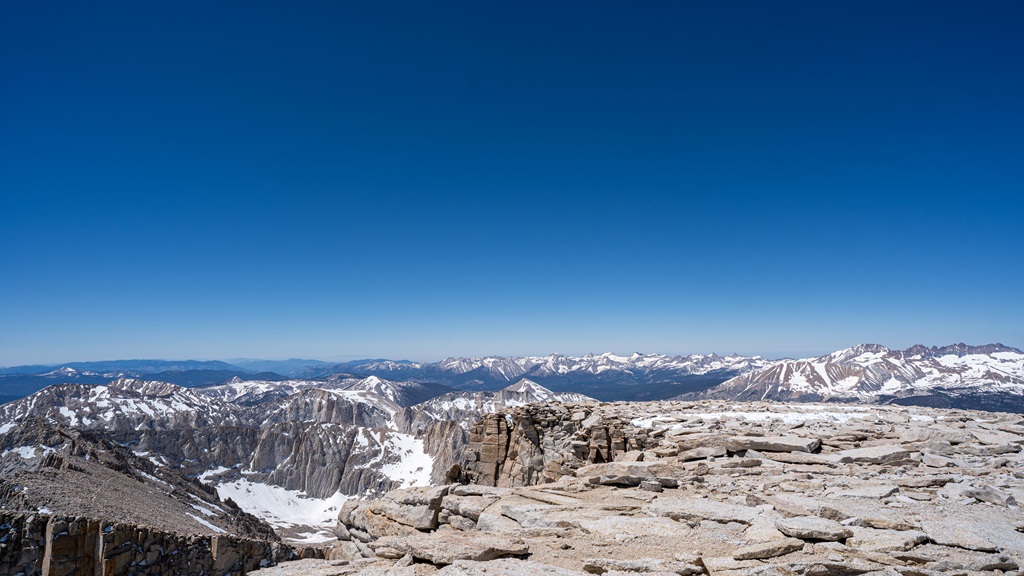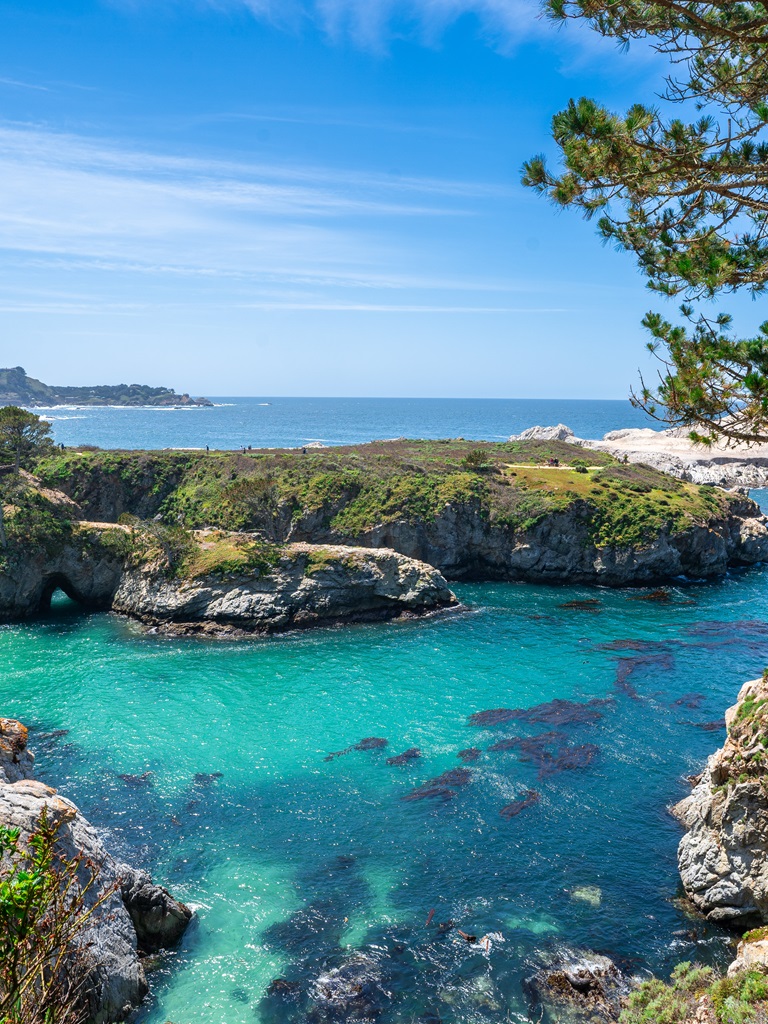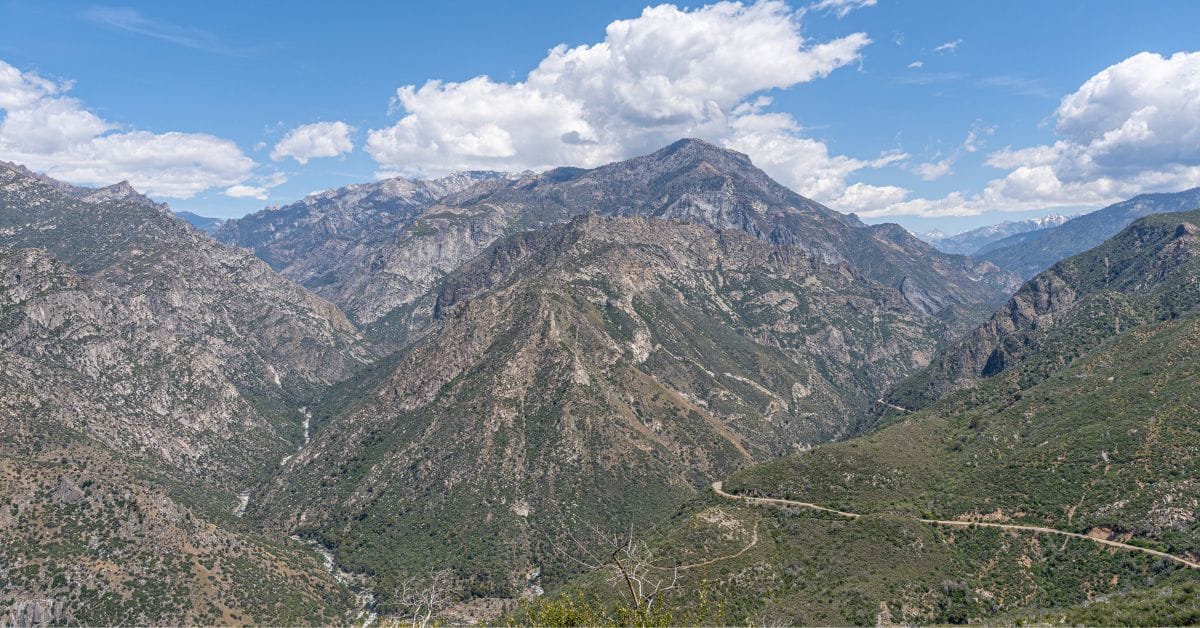
Kings Canyon Scenic Byway is one of the most incredible scenic drives in California! This 38-mile route (from Big Stump Entrance to Road’s End) will take you past breathtaking scenery and jaw-dropping geological displays. 😍
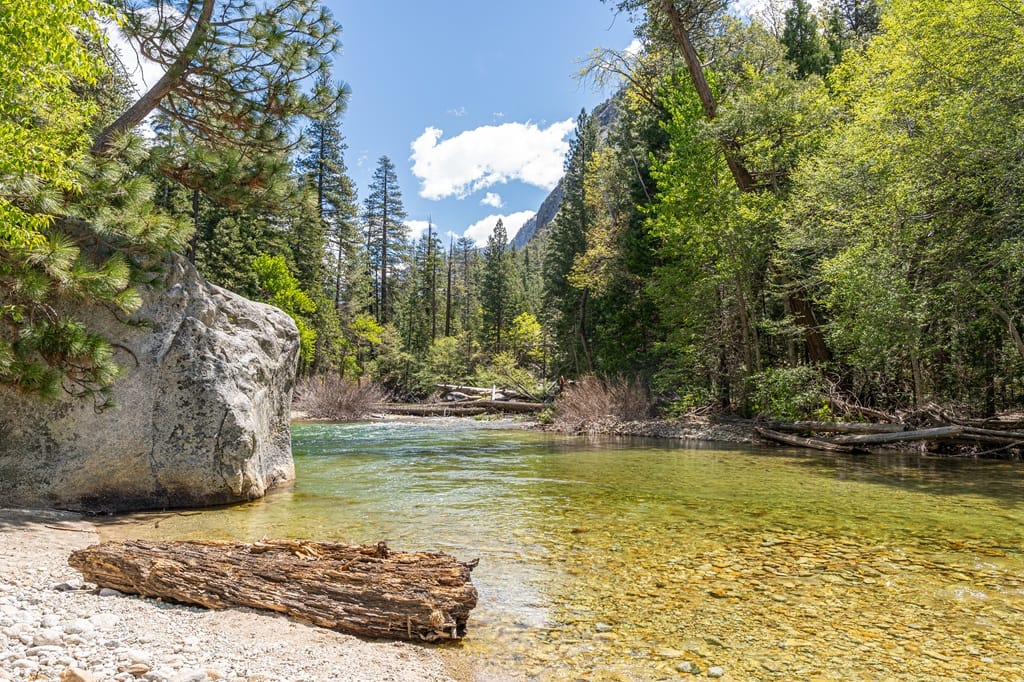
Along this drive you will see giant sequoia trees, stunning vista points, roaring waterfalls, the crystal-clear King River, lush meadows, a marble cavern, and stunning rocky peaks.
Beginning at the Big Stump Entrance in Kings Canyon National Park, the road ascends to an elevation of 6,800 feet near Grant Grove, descends about 3,700 feet through the Giant Sequoia National Monument and into the deep Kings Canyon, eventually re-enters Kings Canyon National Park, and ends at Road’s End near Cedar Grove which sits at around 5,000 feet.
Plan to spend most of your day exploring all that the Kings Canyon Scenic Byway has to offer. My husband and I recently visited this area for the first time and immediately fell in love!
It’s true when they say Kings Canyon National Park is underrated. Like what do you mean you can drive down into one of the deepest canyons in North America? 🤯
Ready to explore more of Kings Canyon National Park beyond the giant sequoias? Read my complete guide to learn everything you need to know about the Kings Canyon Scenic Byway!
Affiliate Disclaimer: Some links on this page may be affiliate links, meaning I may earn a small commission at no extra cost to you. As an Amazon Associate, I earn from qualifying purchases. Thanks for supporting the blog! 🫶
- Overview of the Kings Canyon Scenic Byway Drive
- Kings Canyon Scenic Byway Stops and Hikes
- Kings Canyon Scenic Byway Map and Chart
- Tips for Driving Kings Canyon Scenic Byway
- FAQs: Kings Canyon Scenic Byway
- More Things to Do in Kings Canyon National Park
- What to Bring to Kings Canyon National Park
- Places to Stay in Kings Canyon National Park
- Conclusion
Kings Canyon National Park Trip Info
📍 Location: California, USA
🗓️ Best Time to Visit: May-October
🏞️ Ideal Trip Length: 1-2 days
✈️ Closest Airport: Fresno Yosemite International (1.25 hours from Kings Canyon Visitor Center)
🏨 Where to Stay: John Muir Lodge, Grant Grove Cabins, and Cedar Grove Lodge in Kings Canyon, Wuksachi Lodge and Montecito Sequoia Lodge in Sequoia, or Gena’s Sierra Inn in Dunlap
🚙 Getting Around: Rent a vehicle from rentalcars.com or discovercars.com
💵 Entrance Fee: $35 per vehicle (7 days) or buy an America the Beautiful Pass (covers the entrance fee for 1 year). There are new non-resident fees – learn more here
🤩 Check out my Kings Canyon National Park Guide for more travel, hiking, and seasonal guides
Overview of the Kings Canyon Scenic Byway Drive
Kings Canyon Scenic Byway is just Highway 180, but the section of the highway from the Sierra Nevada foothills to the end of the road is so amazing that they had to give it a special name.
Highway 180 starts in Mendota, runs through the San Joaquin Valley, passes through Fresno, and ends in Kings Canyon National Park. The spot at the end of the road is literally called “Road’s End.”
According to the National Park Service, the Kings Canyon Scenic Byway begins at Hume Lake Ranger District near the town of Dunlap. Starting here, it’s about a 54-mile (87-km) drive to reach Road’s End.
For the purpose of this blog post, we will begin from the Big Stump Entrance in Kings Canyon National Park. Starting from here, it’s about 38 miles (61 km) one way.
🐶 Pet Tip: You will actually drive through both Kings Canyon National Park and Giant Sequoia National Monument which is within Sequoia National Forest. Be aware that pets are not allowed on any trails within the national park but are allowed on most trails within the national forest! They must be on a leash at all times and please pack out their poo!
💵 Kings Canyon Entrance Fee:
Entrance to Kings Canyon National Park costs $35 per vehicle for a 7-day pass. However, if you have the America the Beautiful Annual Pass, your entry is free!
For those who love exploring national parks, investing in the Annual Pass is a smart choice. At just $80, it grants you access to over 2,000 federal recreation sites across the country!
FEE UPDATES! Beginning January 1, 2026, non-U.S. residents (without an annual pass) will pay a $100 per person in addition to the standard entrance fee. The Annual Pass for non-US residents will cost $250.
📍 Directions: From Fresno or Visalia, hop on Highway 180 heading east towards Kings Canyon National Park. Once you enter through the Big Stump Entrance, continue along Highway 180 which is now the Kings Canyon Scenic Byway.
🗺️ Kings Canyon Scenic Byway Length:
- From Hume Lake Ranger District – 54 miles (87 km) one way or 108 miles (174 km) roundtrip
- From Big Stump Entrance – 38 miles (61 km) one way or 76 miles (122 km) roundtrip
🚗 Total Drive Time: Starting from the Big Stump Entrance, it’ll be about 2.5 to 3 hours roundtrip (this does not include stopping at viewpoints or hiking trails)
🌷 Best Time to Visit: In my opinion, the best time to visit is either late spring (May) for big waterfalls and less crowded trails or late summer/early fall (September-October) for warm temperatures but not too hot and great time for swimming as the river is calmer.
❄️ Winter Closure: A portion of the Kings Canyon Scenic Byway (Highway 180), from the Hume Lake turnoff to Road’s End, closes seasonally sometime between November-April. Check road status if you plan to visit anytime in October, November, April, or May to make sure it’s open before you go!
Kings Canyon Scenic Byway Stops and Hikes
There are plenty of fun things to do along the Kings Canyon Scenic Byway from beautiful roadside viewpoints, short and easy hikes, waterfalls, a cavern, and river access for swimming.
Here are 17 incredible things to do when driving down the Kings Canyon Scenic Byway! 👇
1. Big Stump Trail
The Big Stump Trail, also called the Big Stump Loop Trail, is a great first stop. The trail begins at the Big Stump Picnic Area just 0.7 miles (1.1 km) from the Big Stump Entrance.
🥾 Big Stump Trail Stats:
- Length – 2 miles (3.2 km) roundtrip
- Elevation Gain – 200 feet
- Difficulty – Easy
- Pet-friendly? No
- Wheelchair Accessible? No
- Highlights – Big Stump (Mark Twain Stump), The Resurrection Tree, Old Adam, Shattered Giant, The Sawed Tree, and Big Stump Meadow
🅿️ Big Stump Trailhead/Parking: As mentioned earlier, this hike starts from the Big Stump Picnic Area. There is a big parking lot with about 40 parking spots and a few extra big spots for buses and RVs. You will also find restrooms (flush toilets), covered picnic tables, and drinking water.
📍 Google Maps Location: Big Stump Picnic Area
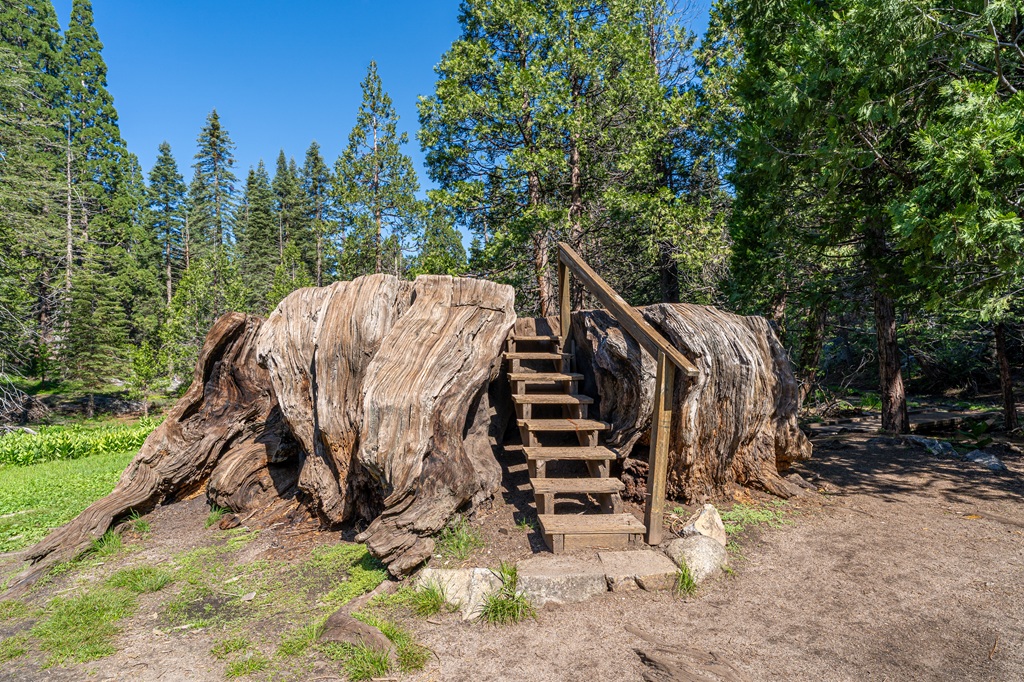
🌳 Hike Details: The main highlight for this hike is the Big Stump. It used to be known as the Mark Twain Tree and was 16 feet in diameter! Sadly, in 1891, the US Army cut the tree down so it could be displayed at the American Museum of Natural History in New York City.
It would have been a more incredible display if they would’ve left it standing. Now, all that’s left is a giant stump. There are steps that lead to the top of the stump so you can get a better sense of how massive this tree was.
Along the trail, you will see more giant sequoia stumps where living giant sequoias used to stand but they too were cut down by the logging industry. I’m happy to stay that the practice of logging giant sequoias is now illegal – we must protect these beautiful trees at all cost!
Anyway, this hike is perfect for families and those looking for an easy walk with views of giant sequoias, giant stumps, and a meadow.
Instead of completing the entire loop, you can hike to the Big Stump and back for a total of 1.4 miles (2.3 km) roundtrip. If you only want to see the Big Stump, you could park at the roadside parking near the Big Stump Entrance and hike to the Big Stump and back which is only 0.2 miles (0.3 km) roundtrip!
✨ READ THIS: Big Stump Trail Hiking Guide
2. Kings Canyon Visitor Center
Located in Grant Grove Village at 6,500 feet in elevation, the Kings Canyon Visitor Center is a convenient place to stop before heading further down Highway 180. It’s only a 2.5-mile (4-km) drive from the Big Stump Picnic Area.
📍 Google Maps Location: Kings Canyon Visitor Center
You can stock up on some supplies, such as maps, snacks, drinks, and talk to a park ranger to learn more about the Kings Canyon Scenic Byway. You will also find a gift shop and restrooms with flush toilets.
You can learn more about giant sequoias, Kings Canyon, and the High Sierra through exhibits and short films. Operating hours can vary by season. Find more information about visitors center in Sequoia and Kings Canyon HERE.
3. General Grant Tree
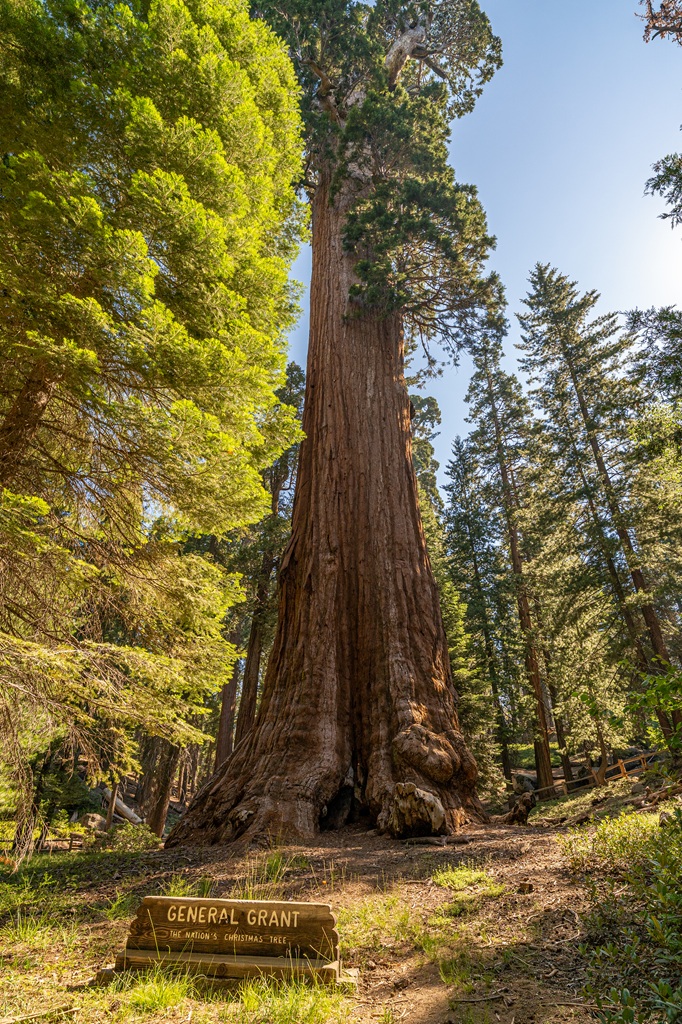
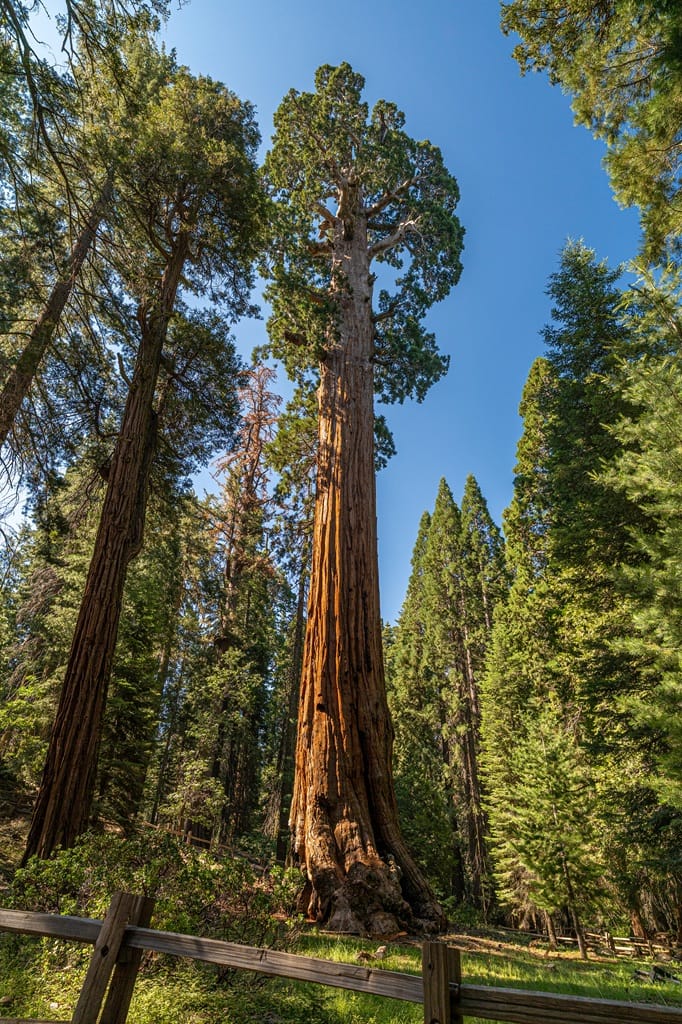
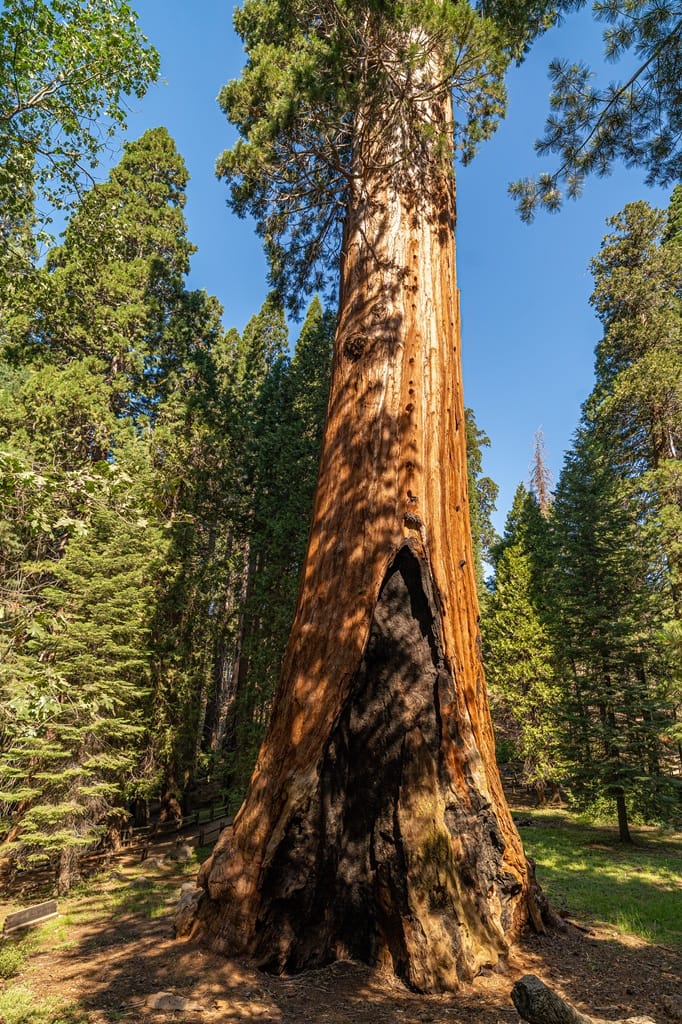
The General Grant Tree is a must-see when visiting Kings Canyon National Park! It’s the second largest tree in the world (by volume). What’s the #1 largest you ask? The General Sherman Tree which is located next door in Sequoia National Park!
You know what’s funny. So many sources, even a few National Park Service pages, state that this is the second largest tree. But apparently, the President Tree in Sequoia National Park is actually the second largest if you include its branches. Like why wouldn’t you include the branches in the total volume?
So, from my research, it seems like the General Grant Tree is really the third largest, the President Tree is the second largest, and the General Sherman Tree is the first. You can find the President Tree along the Congress Trail in Sequoia National Park.
The General Grant Tree is located within Grant Grove which is a 90-acre sequoia grove. From the Kings Canyon Visitor Center, drive 1 mile (1.6 km) to the General Grant Tree parking lot. You will have to veer onto Grant Tree Road off Highway 180 for a short bit before reaching the parking area.
🥾 General Grant Tree Trail Stats:
- Length – 0.6 miles (1 km) roundtrip
- Elevation Gain – 30 feet
- Difficulty – Easy
- Pet-friendly? No
- Wheelchair Accessible? “While paved, the trail has steep sections and is not designated as wheelchair-accessible” – NPS
- Highlights – General Grant Tree, Fallen Monarch (walk inside a fallen giant sequoia), Centennial Stump, Gamlin Cabin, and educational placards along the trail
- General Grant Tree Trail Map
🌳 General Grant Tree Stats:
- Height – 268.1 feet
- Weight – 1,254 tons
- Ground Circumference – 107.5 feet
- Trunk Volume – 46,608 cubic feet
- Age – 1,700 years old
🅿️ General Grant Tree Trailhead/Parking: This hike starts from the General Grant Trailhead which is located at the end of Grant Tree Road. The parking lot is huge with plenty of spots, but this is the most popular area in Kings Canyon National Park so I recommend getting there early. Buses and RVs can park here too! You will also find restrooms (flush toilets) and drinking water.
📍 Google Maps Location: General Grant Tree Trailhead
⛰️ Hike Details: This short and easy loop trail takes you through the Grant Grove where you will marvel at the General Grant Tree, walk through a fallen giant sequoia, read educational placards about the area, and see other cool highlights like a historical cabin and giant sequoia stump.
The General Grant Tree was cool and all but walking through the trunk of a fallen giant sequoia was really fun! If you have kids, they’ll love it!
The General Grant Tree sits at an elevation of about 6,300 feet. Thankfully, the General Grant Tree Trail doesn’t have much elevation gain so you shouldn’t be too affected by the altitude. Unless you have medical conditions that make you more sensitive the high elevations – if that’s the case, take breaks frequently and stay hydrated!
Once you reach the General Grant Tree, you can walk along a paved path around the tree. Please stay behind the fence! It’s there to protect the tree for many, many generations. At the backside of the tree, you will see a huge burn scar from past wildfires.
🤩 More Fun Facts:
- In 1926, President Calvin Coolidge designated the General Grant as the Nation’s Christmas Tree. Every year in December, the tree is honored as a national shrine and Christmas tree. This event, known as the “Trek to the Nation’s Christmas Tree” has been going on since 1926.
- In 1956, President Eisenhower declared the General Grant Tree to be a national shrine. It was dedicated to the men and woman in the Armed Forces who served and fought for the United States.
4. McGee Vista Point
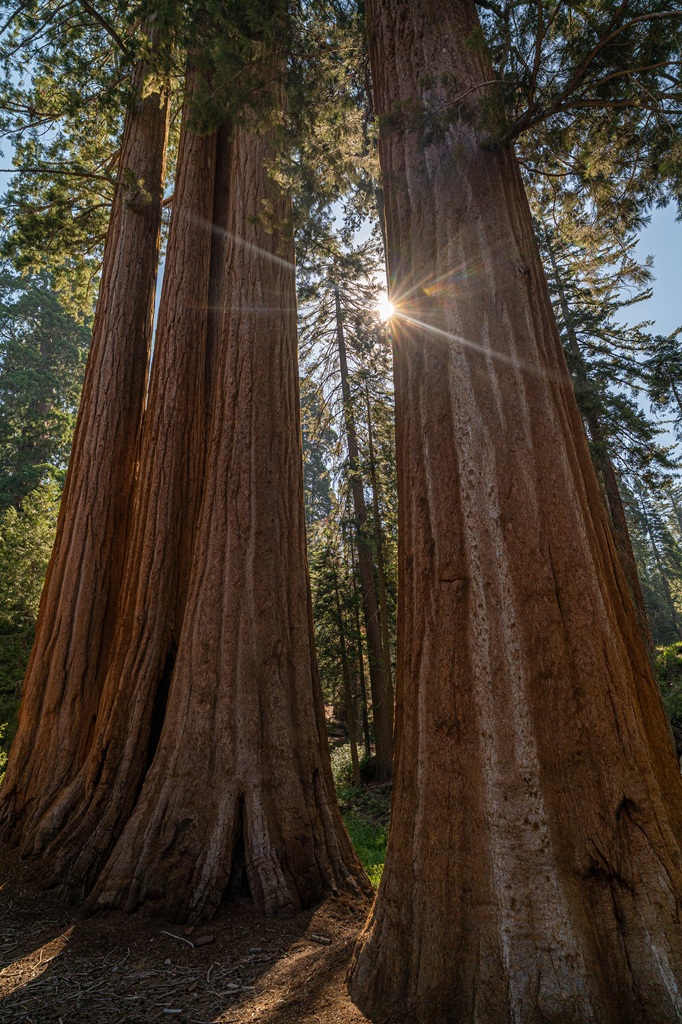
Next stop is the first vista point along the Kings Canyon Scenic Byway! McGee Vista Point offers views of the Sierra Nevada foothills.
📍 Google Maps Location: McGee Vista Point
You will also see the effects of wildfires in this area. In 1955, the McGee Fire burned through this area. Then in 2015, the Rough Fire reburned the area.
This viewpoint sits at 6,800 feet which is the highest point along the Kings Canyon Scenic Byway. As you continue driving, you will descend deep into the Kings Canyon.
McGee Vista Point is about 3.2 miles (5.1 km) from the General Grant Tree parking lot. Also, you are now out of the national park and in the Giant Sequoia National Monument/Sequoia National Forest.
5. Converse Basin Grove
Converse Basin Grove is one of the largest sequoia groves in the world! It is a beautiful place to visit but it has an unfortunate past.
Between 1892 and 1918, the Sanger Lumber Company (which used to be the Kings River Lumbar Company) logged this entire grove to near extinction through a destructive practice known as clearcutting. They cut down about 8,000 giant sequoias!
It makes me so incredibly sad. Hopefully, we can all learn from awful practices like clearcutting and cutting holes through sequoia trunks as a tourist attraction and do better now and in the future to protect these giants!
Despite the horrific logging practices as well as two high intensity wildfires in the 1900s, the grove is healing. In the last 100 years, new growth giant sequoias and other plants and trees have grown in this area.
Even though many of the giant sequoias were cut down, the Converse Basin Grove is still worth a quick visit! There are a few trails that lead to some notable highlights, such as the Chicago Stump, Stump Meadow, Boole Tree, and Muir Snag.
🌳 Converse Basin Grove Highlights:
- Chicago Stump:
- Trailhead Location – Turn onto Forest Service Road 13S03 and drive about 2 miles (3.2 km) until you see the trailhead to the right.
- Trail Details – Follow the Chicago Stump Trail for an easy 0.5-mile (0.8-km) roundtrip hike to Chicago Stump.
- Significance – The Chicago Stump is the remnant of the General Noble Tree which was cut in 1982 for the World’s Columbian Exposition in Chicago.
- Stump Meadow:
- Location – Stump Meadow is located along Forest Service Road 13S55 about 2 miles (3.2 km) from the turnoff from Highway 180.
- Significance – Stump Meadow is filled with giant sequoia stumps left over from the logging era. Young sequoias have been growing here attempting to bring the grove back to life. Giant sequoias are very resilient despite all that they’ve been through both naturally and human caused.
- Boole Tree:
- Trailhead Location – Turn onto Forest Service Road 13S55 and drive about 2.7 miles (4.3 km) until you see the Boole Tree Trailhead on the right. There are restrooms but no drinking water.
- Trail Details – Follow the Boole Tree Loop Trail for a moderate 2.5-mile (4-km) roundtrip hike to one of the tallest trees in the world – Boole Tree.
- Significance – The Boole Tree stands at 269 feet with a circumference of 113 feet making it the sixth largest giant sequoia tree in the world and the largest in the National Forest system! Because of its size, it was graciously spared during the logging era.
- Muir Snag:
- Significance – The Muir Snag is one of the largest and tallest standing dead trees in the world and believed to have been around 3,500 years old at the time of its death. It’s one of the oldest known giant sequoias!
- Location – I have no idea where this dead sequoia tree is located but it’s within the Converse Basin Grove. Maybe there’s a reason the exact location is not on the internet or maybe I didn’t search hard enough. Is it even still standing? 🤷🏻♀️
🅿️ Directions/Parking: To reach these sites, take either Forest Service Road 13S03 or 13S55 (depending on which spot you want to go to). Seems like there’s small parking lots for the Chicago Stump and Boole Tree.
☀️ Best Time to Visit: Summer is probably the best time because the forest service roads are open and dry. The US Forest Service does not recommend low-clearance vehicles on these roads!
❄️ Seasonal Closure: The Converse Basin Grove is open year-round (unless otherwise stated – check current conditions before going), but the forest service roads close in the winter and typically reopen sometime in May.
🚗 Road Trip Tip: Since this area doesn’t appear to be too popular, I would save this spot for on the way back! There are much more popular spots further down the Kings Canyon Scenic Byway and it’s a good idea to hit those first before the big crowds show up.
6. Indian Basin Grove
From the turnoff for the Converse Basin Grove, drive about 2-3 miles (3.2-4.8 km) to reach India Basin Grove. The history of this smaller grove is the same as the Converse Basin Grove – it was logged.
From 1901 to 1907, the Sanger Lumbar Company logged all the mature trees along with ancient giant sequoias in the area. In the Indian Basin Grove, you will see a graveyard of sequoia stumps. Young sequoias are growing and attempting to heal the grove.
🥾 Indian Basin Grove Trail Stats:
- Length – 1.5 miles (2.4 km) roundtrip
- Elevation Gain – 65 feet
- Difficulty – Easy
- Pet-friendly? Yes, must be on leash
- Wheelchair Accessible? Yes
- Highlights – Giant sequoia stumps left over from the historic logging era
- Indian Basin Loop Trail Map
🅿️ Directions/Parking: The Indian Basin Grove Trailhead is located in the Princess Campground off Highway 180. When the campground is closed, you can park at the campground entrance and walk an extra 0.5 miles (0.8 km) one way to reach the trailhead. Vault toilets can be found here.
📍 Google Maps Location: Indian Basin Grove
⛰️ Hike Details: Today, you can walk along a paved path that takes you into the grove where you can see the remnants of stumps where giant sequoias once stood along with new growth trees and plants. This trail is wheelchair accessible and great for families with young children.
I haven’t hiked this trail yet, but it seems like a nice, quick stop. Like I mentioned above with the Converse Basin Grove, I recommend stopping here on the way out! It doesn’t seem like a very popular spot, so it might be a good idea to save for later.
7. Hume Lake
Sitting at 5,200 feet in elevation, Hume Lake is a man-made reservoir that was created during the historic logging era. Thankfully, that period in history has ended for this area and the lake is now use for recreational purposes.
The lake is located just off Highway 180 about 5 miles (8 km) from Indian Basin Grove. It’s a short detour to reach and worth a visit! Here you will find a Christian camp, privately-owned cabins, and Hume Lake Campground.
📍 Google Maps Location: Hume Lake
Activities at the lake include hiking, fishing, swimming, and boating. I recommend hiking the Hume Lake Loop Trail. It’s an easy 3-mile (4.8-km) loop trail that takes you around the lake. If you’re short on time, you can always just hike a portion of it!
8. Junction View
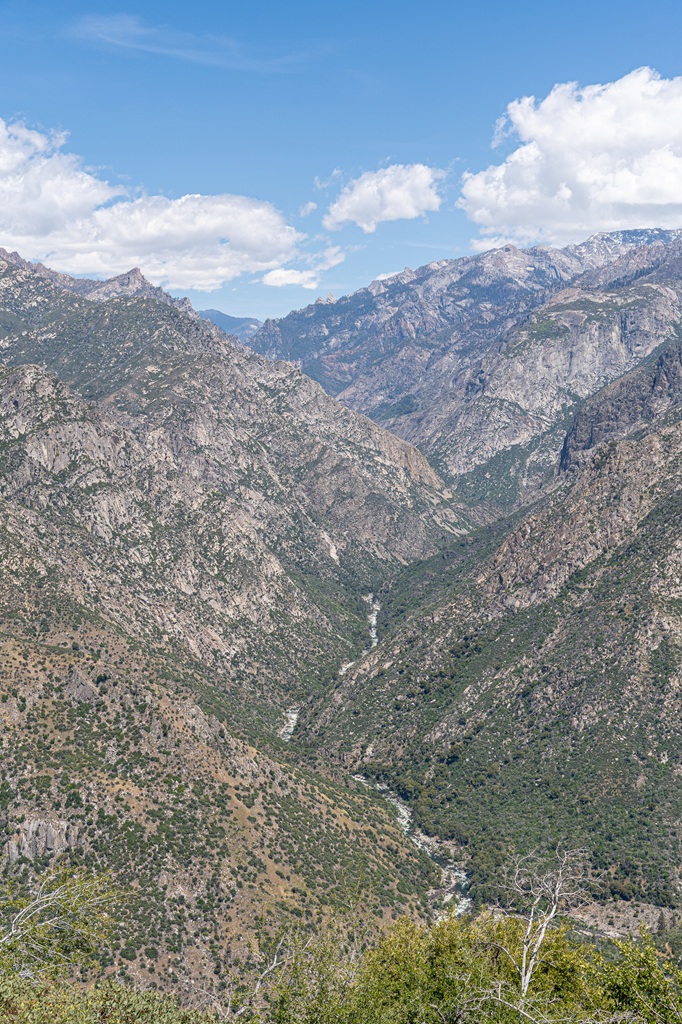
Next stop is one of the most popular viewpoints along the Kings Canyon Scenic Byway – Junction View! It’s about an 8-mile (12.9-km) drive from Hume Lake to reach Junction View. This easily accessible spot has some of the best views of Kings Canyon!
📍 Google Maps Location: Junction View
I highly recommend stopping here to enjoy the scenery. On our most recent trip, my husband and I stopped here twice. The views were just that good! 😍
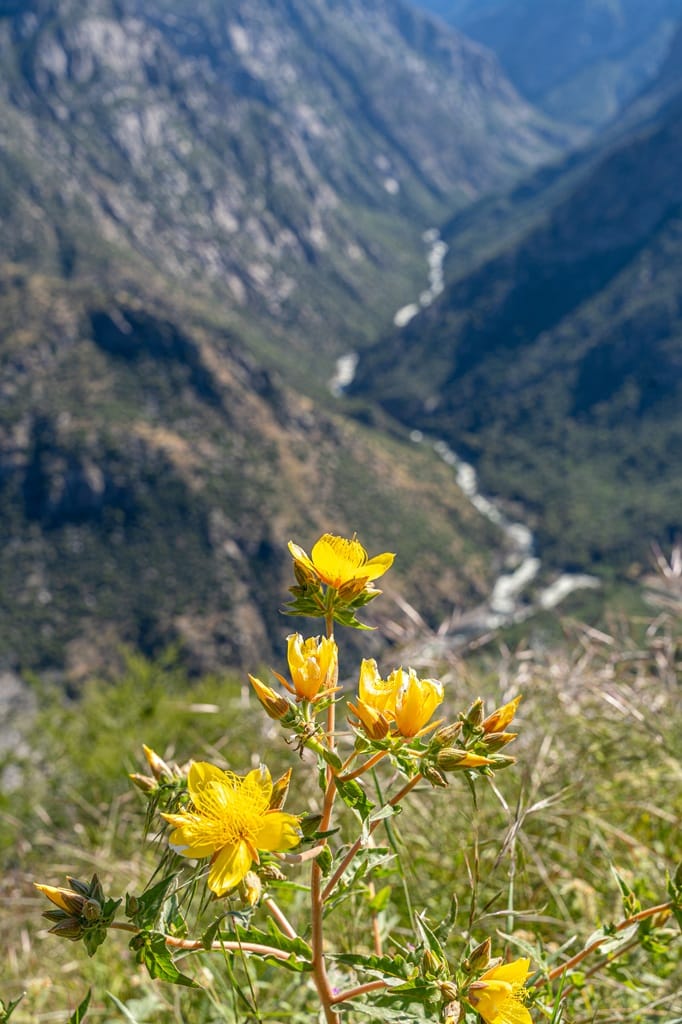
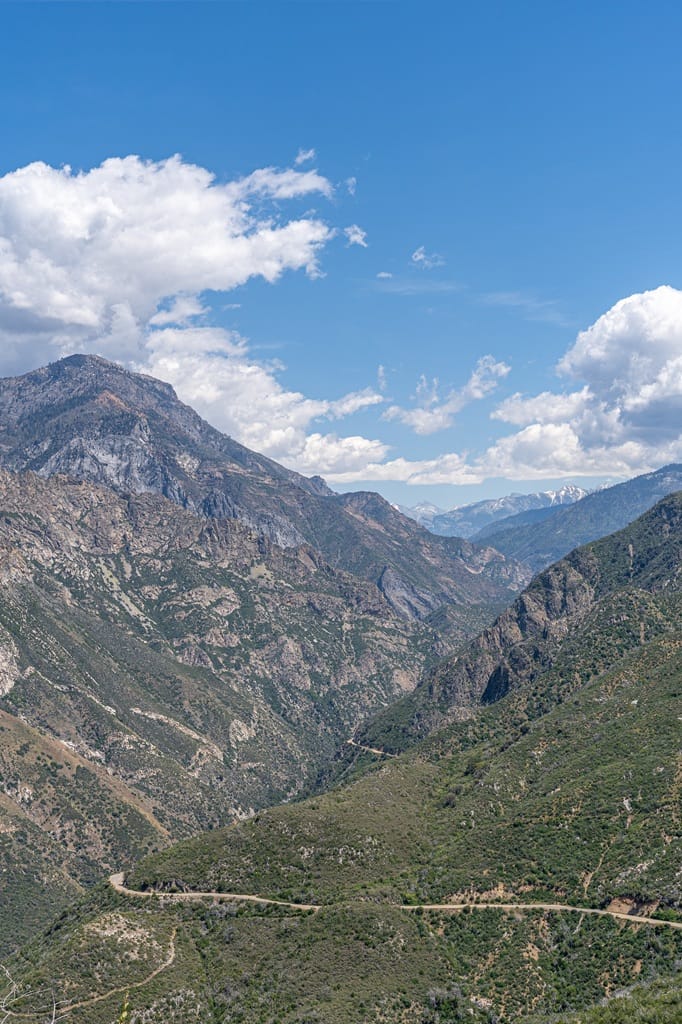
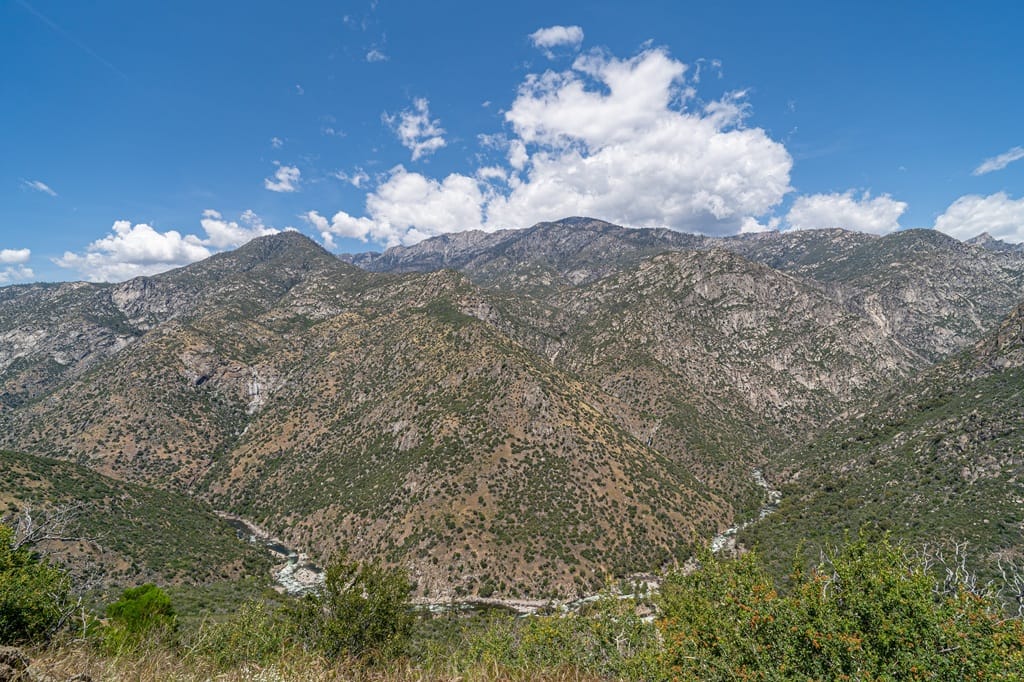
From Junction View you will see the rugged Sierra Nevada mountains and the Middle Fork and South Fork of the Kings River deep in the canyon. There’s an interpretive sign that names the peaks in front of you along with more information about the region’s geology.
After this there will be several other pullouts so you can stop and soak in the views. Just be careful turning in and coming out of some of the spots!
9. Boyden Cavern
Boyden Cavern is a spot you don’t want to miss! I can’t wait to go back and check this off my bucket list. Take a tour to see the incredible geological formations within this marble cave, including stalagmites, flowstone, stalactites, pendants, and shields.
This cavern is privately owned but operates as a concession for the Sequoia National Forest. Not only is the tour inside the cave fun and worth the money, but it’s a great place to stop, eat lunch at the picnic tables, and enjoy the sound of the rushing river!
🅿️ Parking/Directions: Boyden Cavern is located about 8.7 miles (14 km) from Junction View or 22.5 miles (36 km) from the Big Stump Entrance. There is a fairly big parking lot with picnic tables, restrooms, and a gift shop that sells snacks, drinks, and souvenirs.
📍 Google Maps Location: Boyden Cavern
🦇 Boyden Cavern Tour Info:
- Tours typically begin in late April or early May and end in mid-November. Dates of operation may vary based on weather and road conditions. They close seasonally during the same time period as this section of Highway 180.
- You can buy tickets ahead of time online (this is the best option) or try to buy tickets in-person (there may be a wait if you do this).
- Tours last about 45-60 minutes with a short but steep hike into the cave. Once inside, be prepared to duck, turn sideways, walk on loose rocks, stoop down, walk up and down steps, and over slippery areas.
- Bring waterproof shoes as your feet may get wet depending on the season and weather conditions.
- The cave stays cool at about 55°F (13°C) so bring a jacket.
✅ For more information, check out the Boyden Cavern’s website!
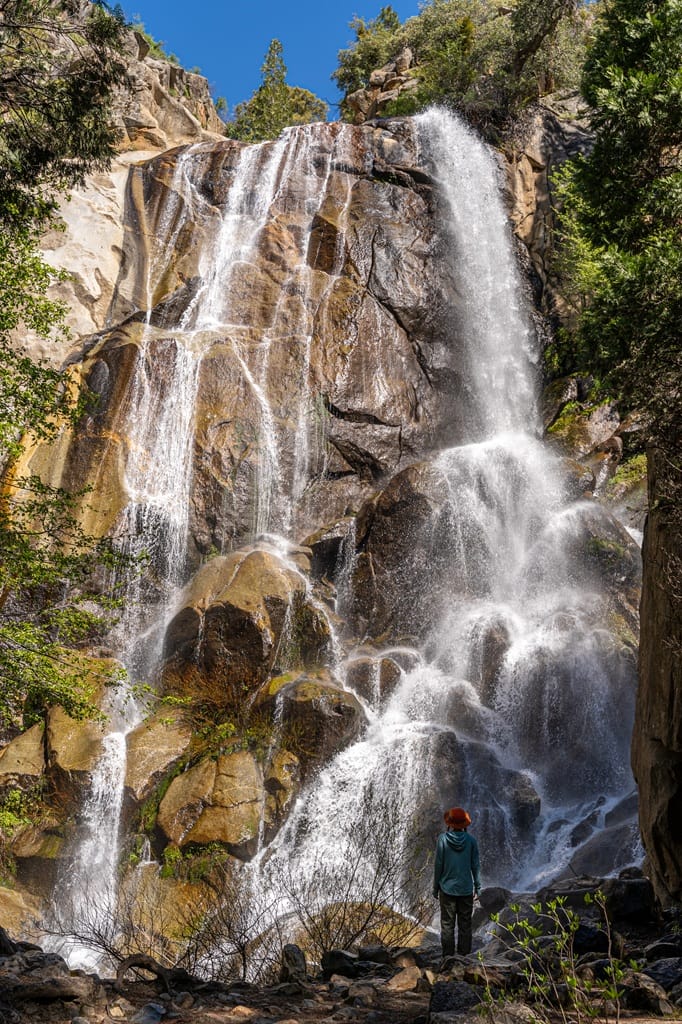
10. Grizzly Falls
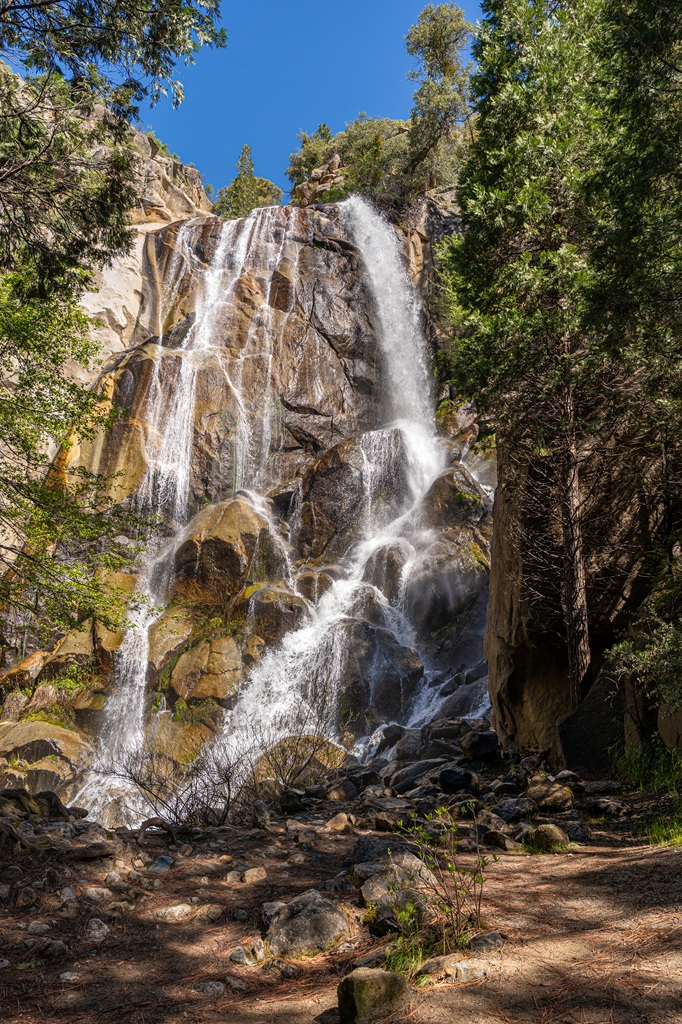
I highly recommend stopping at the Grizzly Falls Picnic Area where you will find a beautiful 80-foot waterfall known as Grizzly Falls. When the waterfall is at its peak flow, usually late spring and early summer, you can feel its power as the mist sprays on you as you get closer.
It’s one of my favorite spots along the Kings Canyon Scenic Byway. If you’re a waterfall lover like me, you’ll appreciate taking the time to see Grizzly Falls. It’s a quick and easy stop so you don’t have to spend too much time here – unless you want to of course. 🙂
You can actually see the waterfall through the trees from the parking lot, but if you’re able to hike the very short trail (0.1 miles / 0.2 km) to get closer, definitely do that!
🅿️ Parking/Directions: Grizzly Falls Picnic Area is about 5 miles (8 km) from Boyden Cavern. The parking lot isn’t too big and it’s a popular spot, so plan to get here early if you can. You will also find vault toilets, bear-proof trashcans, and picnic tables here.
📍 Google Maps Location: Grizzly Falls Picnic Area
11. Kings Canyon National Park Sign
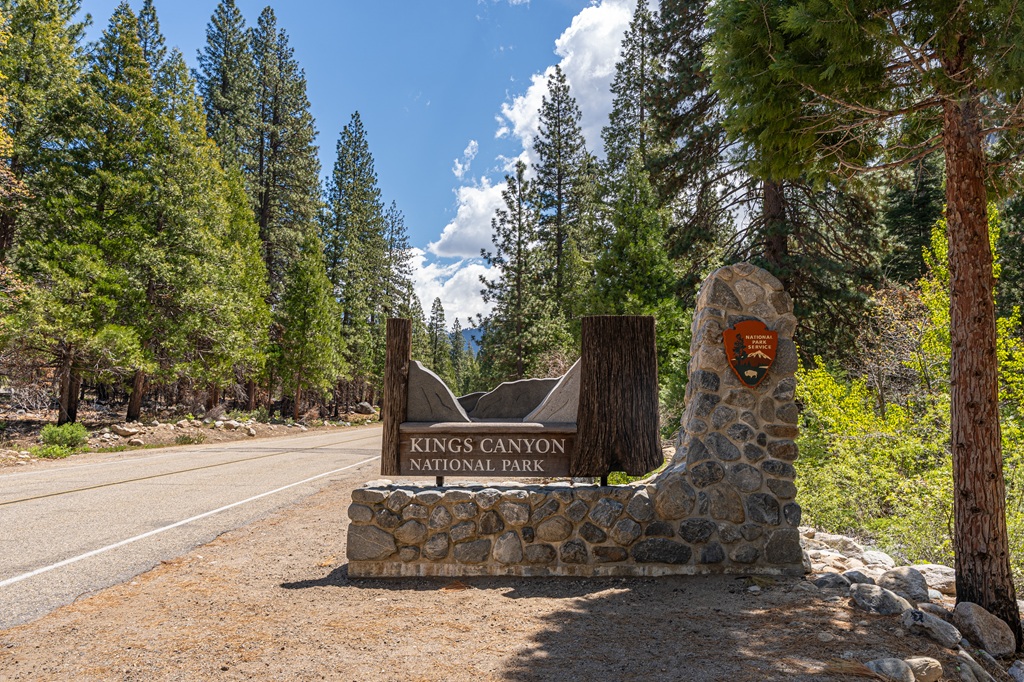
Since leaving Grant Grove, you have been driving in the Giant Sequoia National Monument in the Sequoia National Forest. About 2.7 miles (4.3 km) from Grizzly Falls Picnic Area, you will re-enter Kings Canyon National Park!
There is an official national park sign where you can park in a very small pullout and take a quick picture. It’s definitely not a “must-stop spot” but if you enjoy taking pictures of signs then don’t miss the Kings Canyon National Park sign!
📍 Google Maps Location: Kings Canyon National Park sign
12. Cedar Grove Village
Once you re-enter Kings Canyon National Park, in just 2 miles (3.2 km) you will reach Cedar Grove Village. Here you will find a few campgrounds, the Cedar Grove Visitor Center, and the Cedar Grove Lodge.
📍 Google Maps Location: Cedar Grove Village
You will also find the Cedar Grove Market where you can purchase supplies and groceries. The Cedar Grove Grill offers light meals and snacks. There are picnic tables, bathrooms, showers, and laundry facilities.
Cedar Grove Village is open seasonally from May to mid-November (dates may vary depending on weather and conditions). It sits at 4,600 feet in elevation so expect warm days and cool nights.
If you need more information about the area, make sure to check out the Cedar Grove Visitor Center. If not, then continue to the next point of interest.
13. Knapp’s Cabin
From the Cedar Grove Visitor Center, drive about 2.3 miles (3.7 km) to Knapp’s Cabin. We didn’t stop here because the cabin looked a bit underwhelming – I saw a quick glimpse of it as we drove by.
📍 Google Maps Location: Knapp’s Cabin
Knapp’s Cabin was named after a wealthy businessman, George Own Knapp, who used to spend a lot of time in this area of Kings Canyon. The cabin was designed to be used for storage rather than a residence. By 1940, the cabin was abandoned and since the 1950s, the National Park Service has been managing this historic structure.
The cabin has remained unaltered except for a new shake roof which was added by the National Park Service in 1966. It’s a reminder of the recreational activities that took place in this area in the early 1900s.
14. Roaring River Falls
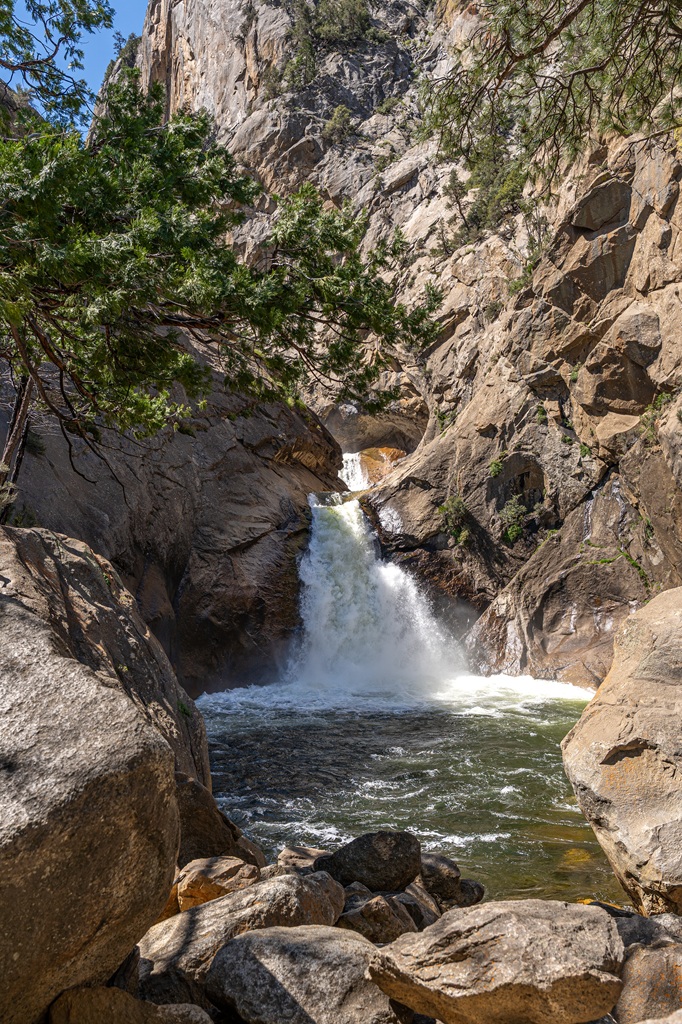
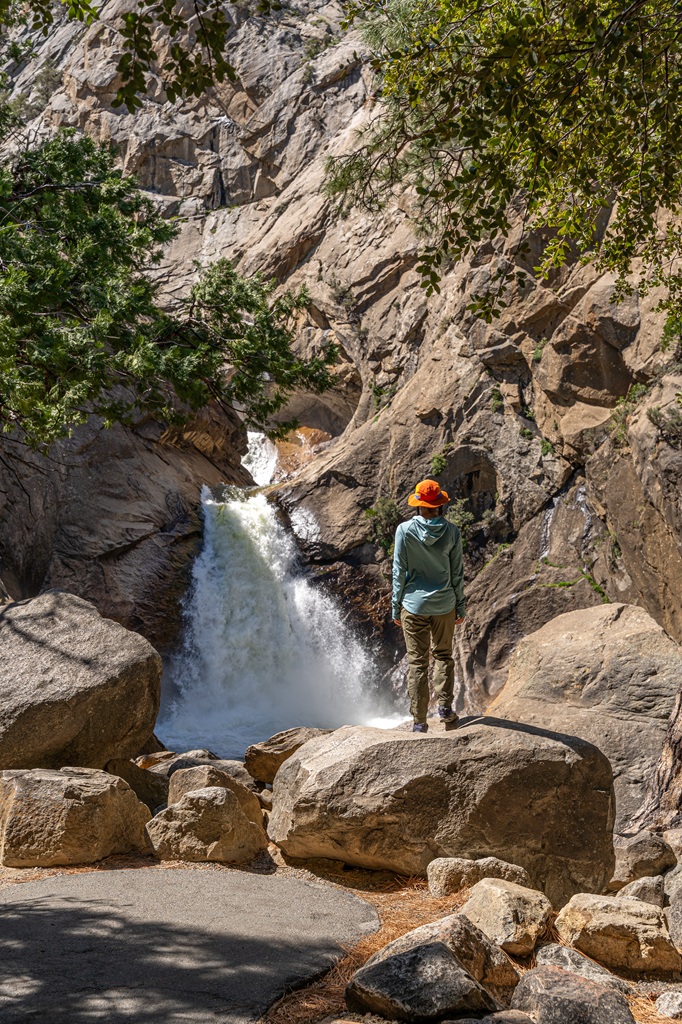
There are two easily accessible waterfalls along the Kings Canyon Scenic Byway. The first was Grizzly Falls and the second is Roaring River Falls – a powerful 40-foot waterfall.
The short hike to reach the waterfall is a must-do when visiting Kings Canyon! The best time to see Roaring River Falls is late spring when snowmelt creates a huge waterfall. It actually does sound like it’s roaring!
🥾 Roaring River Falls Trail Stats:
- Length – 0.3 miles (0.5 km) roundtrip
- Elevation Gain – 30 feet
- Difficulty – Easy
- Pet-friendly? No
- Wheelchair Accessible? Yes, but be aware the paved path has some incline that can be difficult to navigate for some people
- Highlights – Roaring River Falls
- Roaring River Falls Trail Map
🅿️ Roaring River Falls Trailhead/Parking: The Roaring River Falls Trailhead is just a 1-mile (1.6-km) drive from Knapp’s Cabin. The parking lot has about 16 spots with one being a handicap accessible spot. It’s a popular area so spots can fill up quickly during peak season.
📍 Google Maps Location: Roaring River Falls Trailhead
⛰️ Hike Details: The trail to reach Roaring River Falls is entirely paved. The National Park Service says the trail is wheelchair accessible – there’s a bit of an incline so be prepared if you are a wheelchair user.
If you’re looking for a longer hike, follow the River Trail to Zumwalt Meadow. It’s about 3.9 miles (6.3 km) roundtrip and great for hikers of all skill levels.
If you don’t want to hike to the meadow from here, don’t worry! Just retrace your steps back to your car and drive 1.5 miles (2.4 km) to the Zumwalt Meadow parking area. That’s our next stop.
15. Zumwalt Meadow
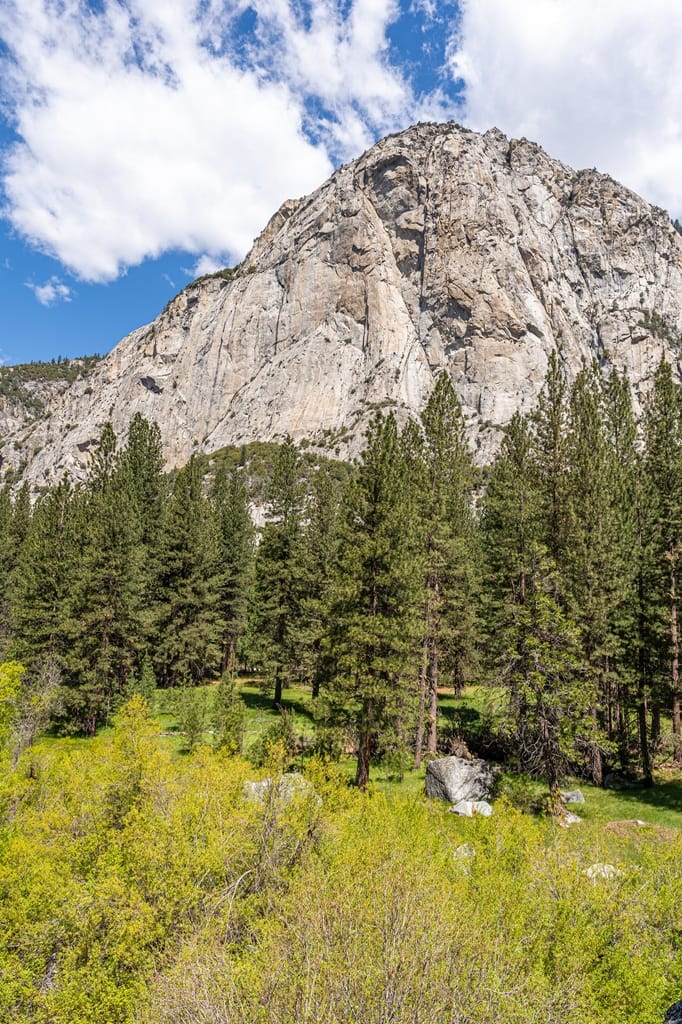
Zumwalt Meadow is one of the park’s most iconic, scenic meadows. Along with Grizzly Falls and Roaring River Falls, this meadow is one of the most popular spots in Kings Canyon.
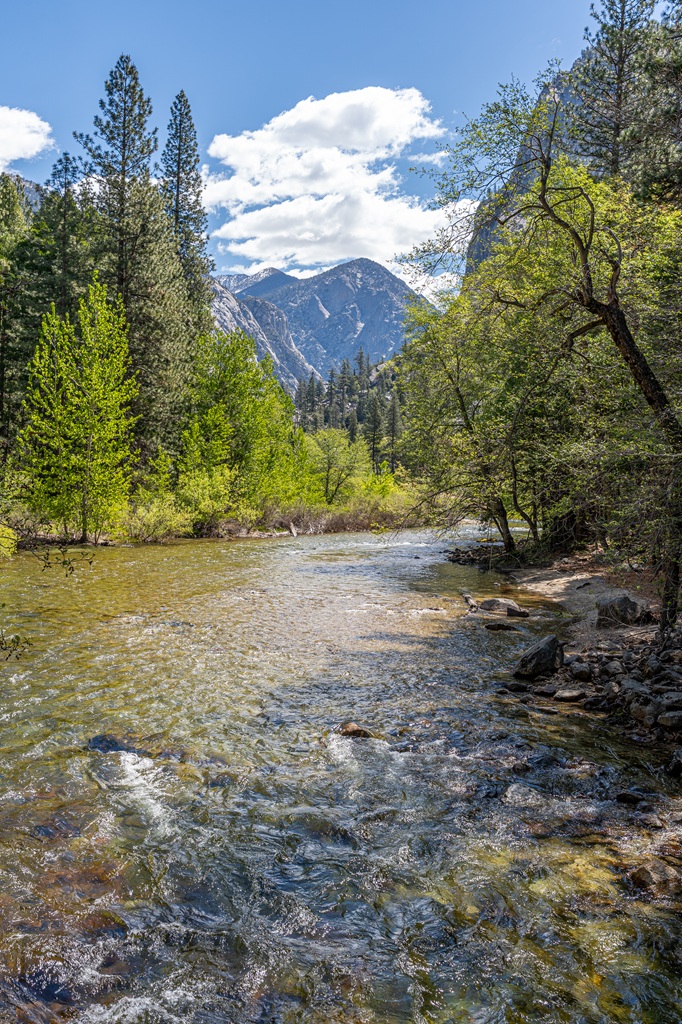
Hike along the trail for beautiful views, have a picnic, and enjoy the sounds of the Kings River as it rushes by. This is a great place to relax and soak in the views. If you’re lucky, you might even see some wildlife in the meadow!
🥾 Zumwalt Meadow Trail Stats:
- Length – 1.5 miles (2.4 km) roundtrip
- Elevation Gain – 155 feet
- Difficulty – Easy to moderate
- Pet-friendly? No
- Wheelchair Accessible? No
- Highlights – Zumwalt Meadow, suspension bridge, and access to Kings River
- Zumwalt Meadow Trail Map
🅿️ Zumwalt Meadow Trailhead/Parking: The Zumwalt Meadow Trailhead is located just 1.5 miles (2.4 km) down the road from Roaring River Falls. The parking lot can hold about 30 vehicles with one handicap accessible spot. You will also find restrooms and picnic tables here.
📍 Google Maps Location: Zumwalt Meadow Trailhead
⛰️ Hike Details: The boardwalk section of the trail that goes through the meadow is currently closed due to either the 2021 KNP Complex Fire, flooding, or winter storm damage (different sources say different things).
Even though the best part is closed, hiking the portion of the trail that is open is definitely worth it. The trail takes you beside the Kings River, over a suspension bridge, through the forest, up and over a rocky hillside where you will get the best views of Zumwalt Meadow, and finally ending just before the trail re-enters the forest.
The trail is easy to follow but the rocky section can be tough for some people. Take your time, use hiking poles if needed, and enjoy the scenery!
16. Road’s End
Road’s End is literally the very end of the Kings Canyon Scenic Byway and Highway 180. This area is basically a starting point for backpackers looking to explore the Sierra Nevada backcountry. There are some day hikes as well as river access for swimming!
📍 Google Maps Location: Road’s End
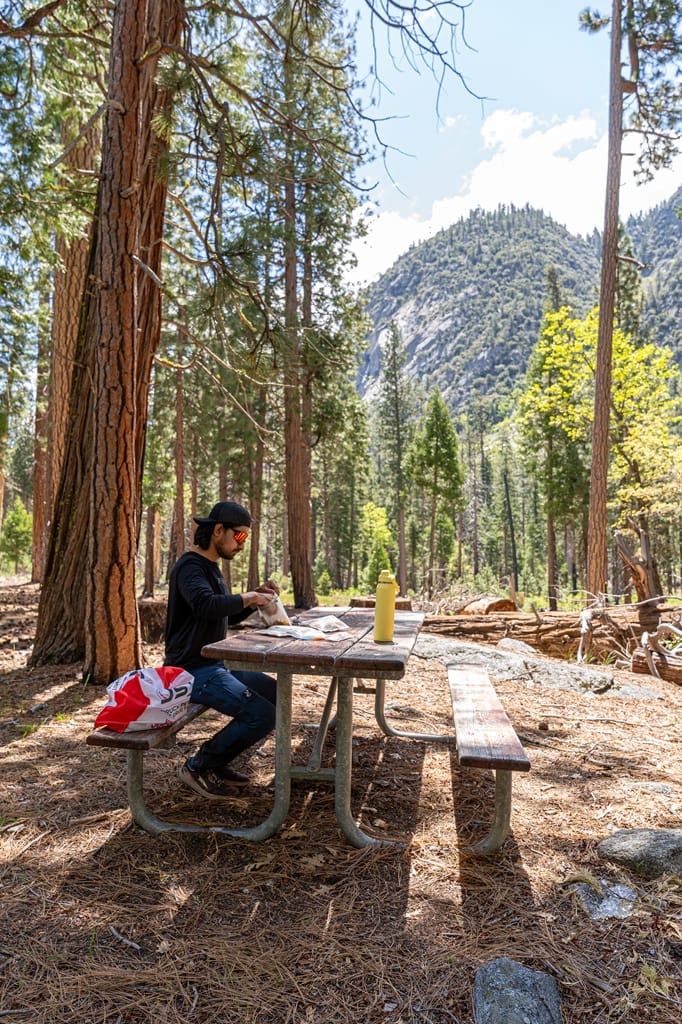
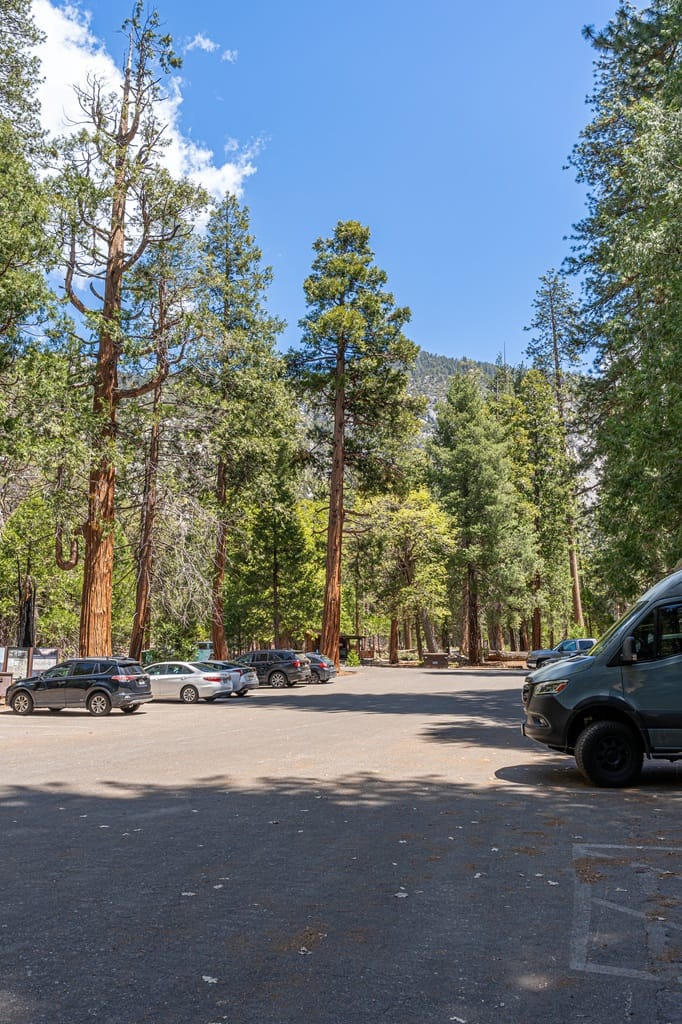
You will also find a wilderness permit office, vault toilets, and picnic tables. My husband and I stopped here for lunch during our most recent trip. It was incredibly peaceful!
I’m sure it can get busy during peak summer months, but if you want some solitude, visit during the weekday soon after the road opens up for the season.
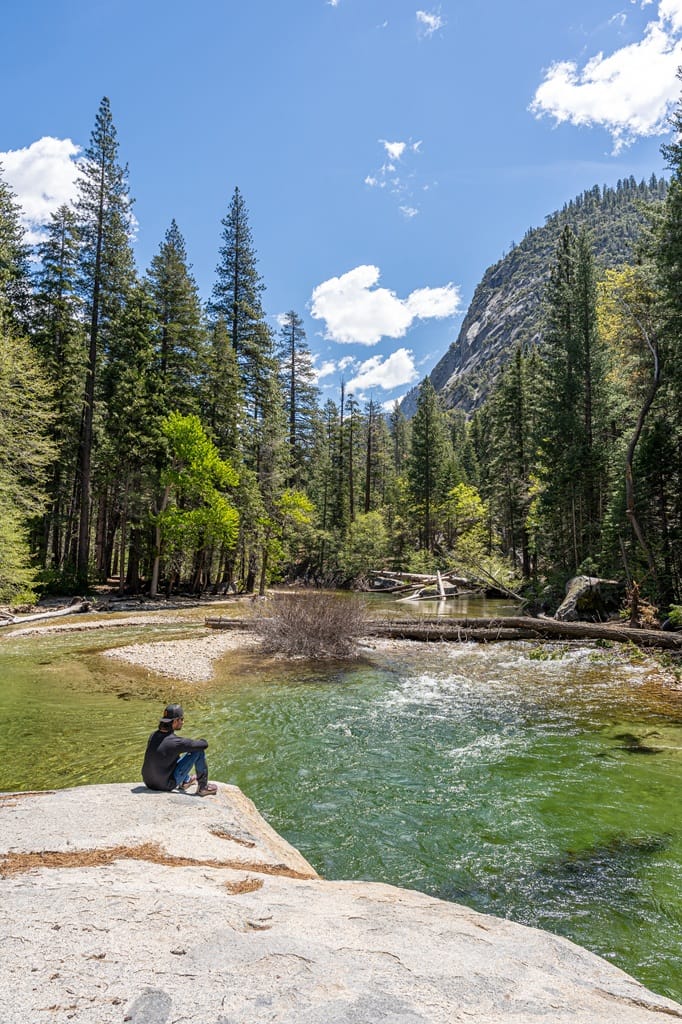
17. Muir Rock
Located just a short walk from the Road’s End parking lot is Muir Rock. This large granite boulder is named after John Muir, a naturalist and environmental advocate who shaped the modern conservation movement.
📍 Google Maps Location: Muir Rock
Some say that John Muir gave speeches at this particular boulder about the importance of protecting natural places like Kings Canyon and the surrounding area.
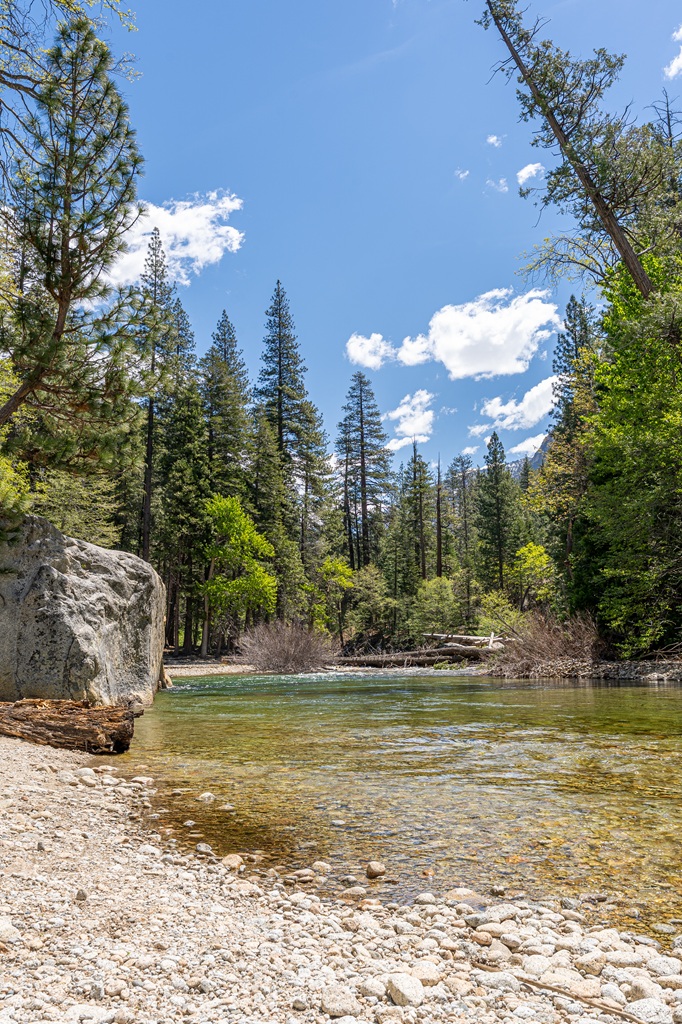
In late summer, when the river is calmer, it’s a great swimming spot. Just be warned, the water is freezing! Some even jump off of Muir Rock into the water – just be careful. There’s a rocky beach on the other side where you can relax and soak in the sun.
Kings Canyon Scenic Byway Map and Chart
Below you will find a Kings Canyon Scenic Byway map that includes all the best stops, must-do hikes, viewpoints, and visitor centers. And I also created a well-organized chart so you will be 100% prepared for this exciting adventure!
Kings Canyon Scenic Byway Map
Kings Canyon Scenic Byway Chart
| Highlight | Miles from Big Stump Entrance | Hiking Trail |
|---|---|---|
| Big Stump (Mark Twain Stump) | 0.7 miles / 1.1 km | Big Stump Trail (2 miles / 3.2 km, easy) |
| Kings Canyon Visitor Center | 3.1 miles / 5 km | No trail |
| General Grant Tree | 4.1 miles / 6.6 km | General Grant Tree Trail (0.6 miles / 1 km, easy) |
| McGee Vista Point | 5.8 miles / 9.3 km | No trail |
| Chicago Stump | 8.2 miles / 13.2 km | Chicago Stump Trail (0.5 miles / 0.8 km, easy) |
| Boole Tree | 10.1 miles / 16.3 km | Boole Tree Trail (2.5 miles / 4 km, moderate) |
| Indian Basin Grove | 9.4 miles / 15.1 km | Indian Basin Grove Trail (1.5 miles / 2.4 km, easy) |
| Hume Lake | 12.7 miles / 20.4 km | Hume Lake Loop Trail (3 miles / 4.8 km, easy) |
| Junction View | 13.8 miles / 22.2 km | No trail |
| Boyden Cavern | 22.5 miles / 36.2 km | Short trail on tour |
| Grizzly Falls | 27.6 miles / 44.4 km | Grizzly Falls Trail (0.1 miles / 0.2 km, easy) |
| Cedar Grove Visitor Center | 32.2 miles / 51.8 km | No trail |
| Knapp’s Cabin | 34.1 miles / 54.9 km | Knapp’s Cabin Trail (0.1 miles / 0.2 km, easy) |
| Roaring River Falls | 35 miles / 56.3 km | Roaring River Falls Trail (0.3 miles / 0.5 km, easy) |
| Zumwalt Meadow | 36.5 miles / 58.7 km | Zumwalt Meadow Trail (1.5 miles / 2.4 km, easy to moderate) |
| Road’s End | 37.4 miles / 60.2 km | No trail |
| Muir Rock | 37.4 miles / 60.2 km | Short easy trail |
Tips for Driving Kings Canyon Scenic Byway
1. Check Road Status: The section of Kings Canyon Scenic Byway from Hume Lake to Road’s End closes seasonally (typically mid-November to April/May, depending on snow levels). Always check current conditions and call 559-565-3341 (press 1, then 1) for up-to-date road conditions.
2. Download Offline Maps: Cell service is very limited once inside the national park and national forest. Download offline maps on Google Maps and trail maps on AllTrails ahead of time. It’s also a good idea to bring a physical map and compass as backup – just in case your phone dies!
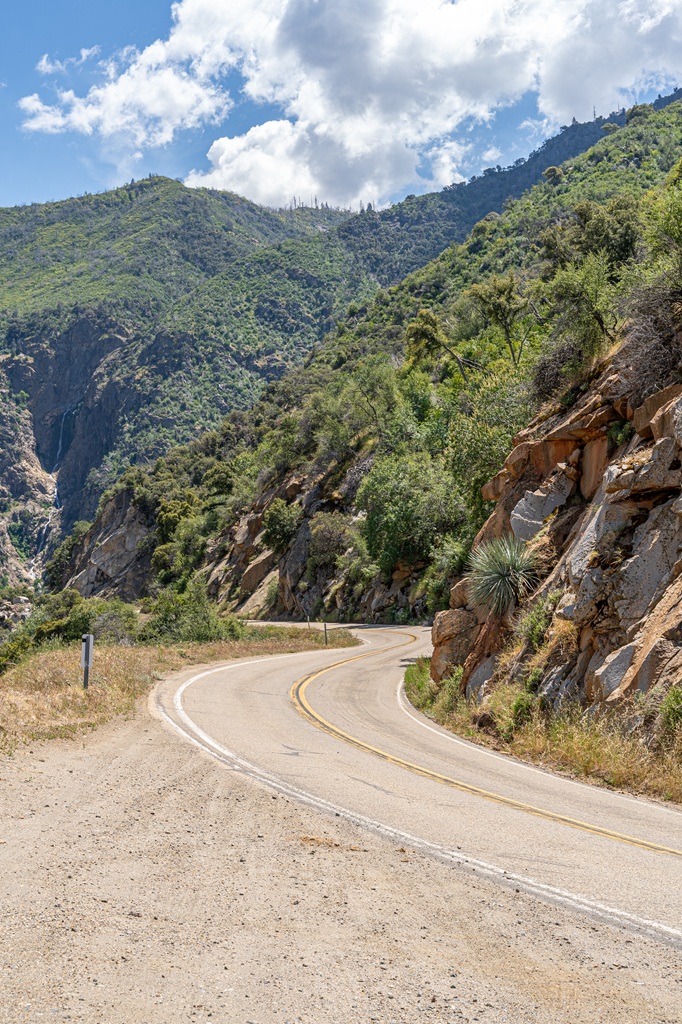
3. Drive Safely: Sections of Highway 180 from Big Stump Entrance to Road’s End are narrow, winding, and full of sharp curves with steep drop-offs. Take your time, enjoy the scenery, and use pullouts to let cars pass if needed. Also, RVs and trailers longer than 24 feet are not recommended!
4. Be Bear Aware: Black bears are active within Kings Canyon National Park and Sequoia National Forest. Follow these guidelines to avoid any negative interactions with a black bear.
🐻 Note: Bear spray is prohibited in Kings Canyon!
5. Respect Nature: Follow Leave No Trace principles – plan ahead, pack out all trash, avoid disturbing wildlife, be considerate of others, and respect the natural beauty of Kings Canyon National Park and Sequoia National Forest.
FAQs: Kings Canyon Scenic Byway
-
How long does it take to drive the Kings Canyon Scenic Byway?
Starting from the Big Stump Entrance in Kings Canyon National Park, it will take about 2 hours and 30 minutes to 3 hours roundtrip. This does not include the time you take to explore different spots along the route.
-
Is Kings Canyon Scenic Byway worth it?
Yes, Kings Canyon Scenic Byway is worth it! In my opinion, it is the best thing to do in Kings Canyon National Park. There’s so much to see and do along this route.
-
Where does the Kings Canyon Scenic Byway start?
According to the National Park Service, the Kings Canyon Scenic Byway begins at Hume Lake Ranger District near the town of Dunlap. Starting here, it’s about a 54-mile (87-km) drive to reach Road’s End.
-
Is the Kings Canyon Scenic Byway drive scary?
Yes, it can be scary for some people as it’s a long, windy road with lots of sharp curves and steep drop-offs. However, if you drive the speed limit and be cautious around turns, you will be fine! Always check road conditions before heading out to make sure it’s open and clear from snow/ice.
More Things to Do in Kings Canyon National Park
Driving the Kings Canyon Scenic Byway usually takes a full day, including all the stops and hikes. But if you’re staying another day or two in Kings Canyon, you might be looking for more things to do.
Check out the list below and add any of these hikes and viewpoints to your itinerary! 👇
Hike to Mist Falls
This popular route begins at Road’s End along the Paradise Valley Trail before continuing onto the Mist Falls Trail. As you gradually make your way deeper into the wilderness, you’ll be rewarded with beautiful views looking back into the canyon below.
The hike is moderate in difficulty the majority of the time, but the final stretch can be quite challenging for some with a short yet steep 600-foot climb up to the waterfall.
At the end, you’ll reach Mist Falls. Just like Vernal Fall in Yosemite National Park, during late spring and early summer, you will feel the refreshing mist wash over you. On a hot day, it’s very much needed to cool off!
🥾 Mist Falls Trail Stats:
- Length – 8 miles (12.9 km) roundtrip
- Elevation Gain – 905 feet
- Difficulty – Moderate
- Pet-friendly? No
- Wheelchair Accessible? No
- Highlights – Mist Falls
- Mist Falls Trail Map
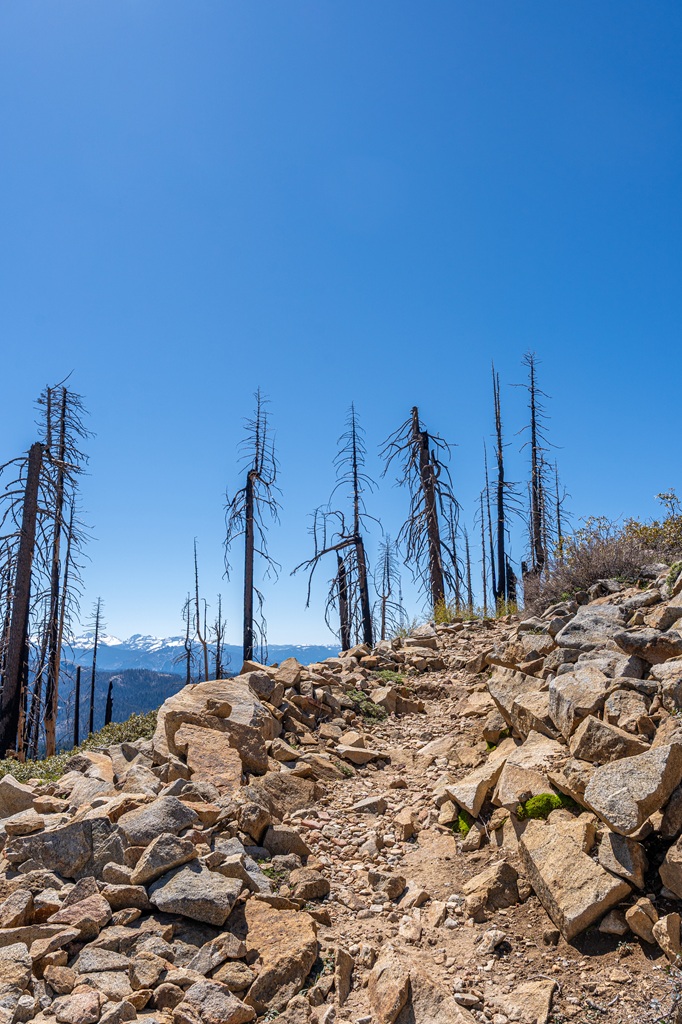
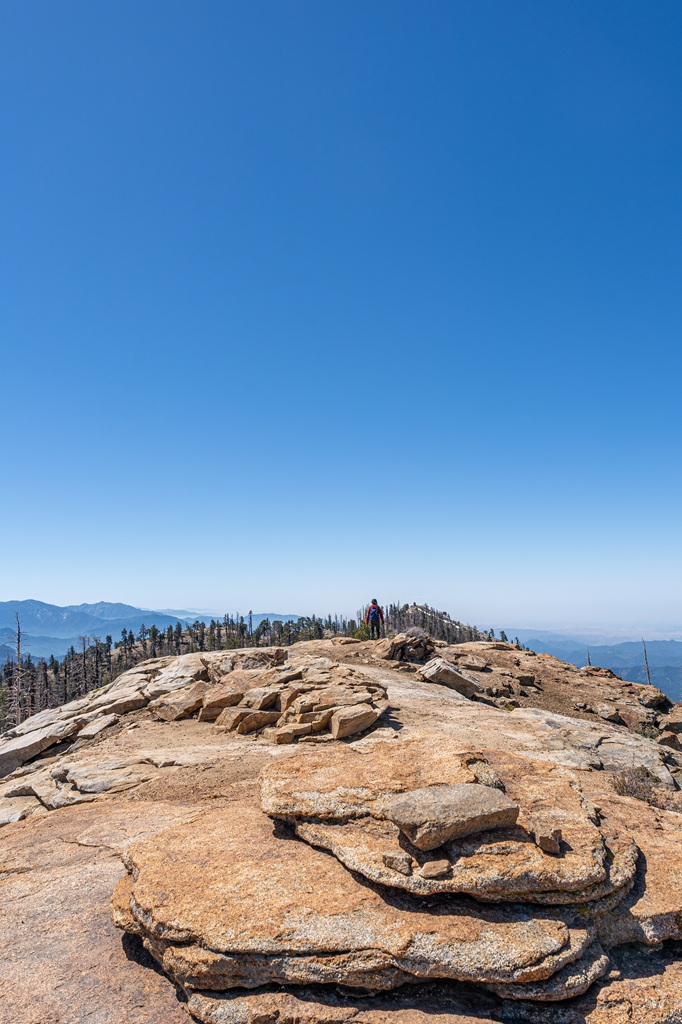
Hike the Big Baldy Trail
The Big Baldy Trail gradually leads up to a giant granite dome with panoramic views of the Great Western Divide, Kings Canyon, and Redwood Canyon.
The summit stands at about 8,200 feet in elevation. It’s definitely worth adding to a 2-day Kings Canyon itinerary!
🥾 Big Baldy Trail Stats:
- Length – 4.7 miles (7.6 km) roundtrip
- Elevation Gain – 1,030 feet
- Difficulty – Moderate
- Pet-friendly? No
- Wheelchair Accessible? No
- Highlights – Incredible views from Big Baldy
✨ READ THIS: Big Baldy Trail Hiking Guide
Watch Sunrise at Panoramic Point
Panoramic Point offers some of the best views in Kings Canyon National Park. The trail to reach the overlook is short, paved, and gently sloped. When the road is open, it’s a quick and easy stop.
At the top, you’ll be rewarded with breathtaking 360-degree views of the High Sierra, Kings Canyon, Hume Lake, and the distant San Joaquin Valley.
It’s also a great spot to watch the sunrise over the mountains in the distance. I read that watching sunrise from Panoramic Point is better than sunset, but I feel like you can’t go wrong with either one!
🥾 Panoramic Point Trail Stats:
- Length – 0.5 miles (0.8 km) roundtrip
- Elevation Gain – 95 feet
- Difficulty – Easy
- Pet-friendly? No
- Wheelchair Accessible? Depends on your ability – the trail is paved and moderately steep with a 6.5% average grade and a top grade of 8.5%
- Highlights – Breathtaking views from Panoramic Point
- Panoramic Point Trail Map
Hike to Buena Vista Peak
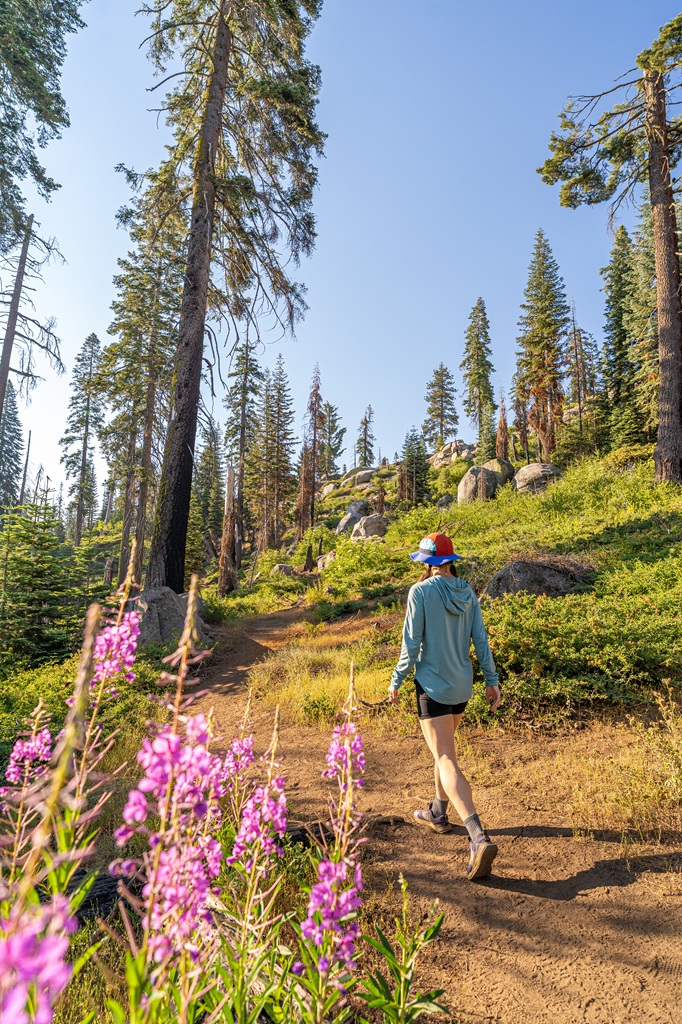
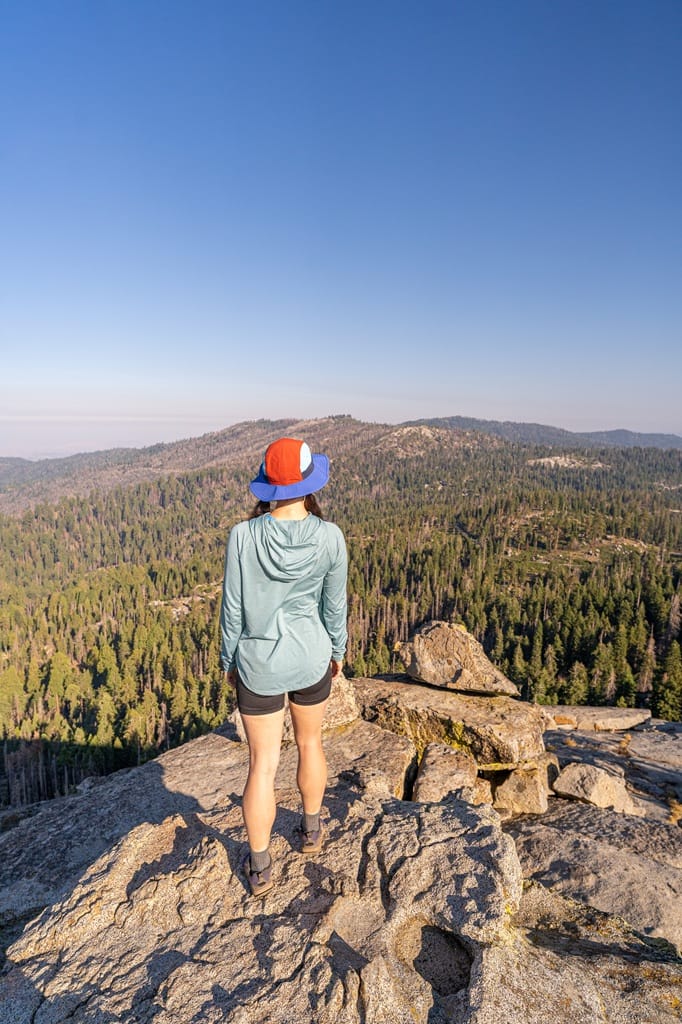
Sitting at 7,605 feet, Buena Vista Peak rewards hikers with incredible panoramic views from the summit. It’s another incredible short hike that’s worth your time!
The trail winds through a scenic mixed conifer forest, passing seasonal wildflowers and massive granite boulders along the way. Once you reach the top, you’ll be treated to 360-degree views of Redwood Canyon, the High Sierra peaks, and Kings Canyon.
🥾 Buena Vista Peak Trail Stats:
- Length – 2 miles (3.2 km) roundtrip
- Elevation Gain – 400 feet
- Difficulty – Moderate
- Pet-friendly? No
- Wheelchair Accessible? No
- Highlights – Stunning views from Buena Vista Peak
✨ READ THIS: Buena Vista Peak Hiking Guide
Planning to visit Sequoia National Park? Check out my travel guides! 👇
What to Bring to Kings Canyon National Park
🎟️ Entrance Pass – You will need to purchase an entrance pass once you reach the entrance station or you can buy the America the Beautiful Pass ahead of time and use that for the entire year.
👚 Layers of Clothing (top) – Pack a moisture-wicking base layer, a fleece mid-layer, an insulated jacket, and an outer shell to protect you from the elements, such as rain and wind. You may not need all these layers, especially in the summer months, but it’s always best to be over-prepared!
Check out my favorite tops 👇
- Base layer: REI Co-op Sahara Shade Hoodie (warm/mild conditions) and REI Co-op Midweight Long-Sleeve Base Layer (cooler conditions)
- Fleece mid layer: Cotopaxi Teca Fleece Full-Zip Jacket
- Down mid layer: Cotopaxi Fuego Hooded Down Jacket
- Outer shell: In the summer I always pack a light windbreaker, such as the Cotopaxi Teca Crop Windbreaker or the RevolutionRace Unit Light Windbreaker. Make sure to also pack a waterproof rain jacket – I like the Patagonia Torrentshell 3L Jacket.
🩳 Hiking Shorts or Pants – Pack a comfortable, durable, and stretchy pair of hiking shorts or pants. Also think about what conditions you might run into, such as warm or cold temperatures, wind and/or rain, bugs, and overgrown trails.
Check out my favorite hiking bottoms 👇
- Cotopaxi Losdos Zip-Off Pants
- RevolutionRace Breezy Ankle Outdoor Pants
- Baleaf Fleece-Lined Jogger Pants
- RevolutionRace Summit Pocket Tights
- Revolution Race Hike & Dive Shorts
🥾 Hiking Footwear – Bring a good pair of hiking boots or shoes with good traction. If I’m not expecting to hike in too much mud or snow, my go-to hiking shoes are the Altra Lone Peak trail runners. They have a wide-toe box, 0 mm heel-to-toe drop, and MaxTrac rubber outsole. Plus, they’re lightweight and so comfy!
🧦 Socks – Moisture-wicking, quick-drying socks are the way to go. My favorite pair of hiking socks are Darn Tough Hiker Micro Crew Cushion Socks. Always pack an extra pair!
🎒 Day Pack – What you plan to do (sightseeing, hiking, etc.), determines what size pack you’ll need. Here is what I typically bring based on what I’m doing that day 👇
- Short walks and sightseeing: Cotopaxi Kapai 1.5L Del Dia Hip Pack
- Short, easy to moderate day hikes: REI Co-op Flash 22L Pack
- Long, moderate to challenging day hikes: REI Co-op Trail 25L Pack or Cotopaxi Luzon Del Dia 24L Pack
🥢 Trekking Poles – Essential for stability, balance, and support when hiking trails, especially on tough, rocky, and uneven terrain. I use REI Co-op Trailmade Trekking Poles and love them!
❄️ Microspikes – Bring a pair of microspikes if you’re visiting in the winter and you’re planning to hike along icy trails. They will give you good traction to avoid slipping! I use Black Diamond Access Spike Traction Device.
🦟 Mosquito/Bug Repellants – In the warmer months, be prepared for annoying gnats, mosquitoes, and flies. Wear long-sleeve clothing, a head net, and use bug spray.
🧤 Extra Warm Layers – If you expect cooler conditions or hiking to higher elevations, make sure to pack extra layers for added warmth, such as gloves, beanie, neck gaiter, and a light jacket.
🗺️ Navigation – Carry a physical topographic map, compass, a satellite messenger (or personal locator beacon), and download offline maps to help you stay on course, find your way in unfamiliar terrain, and call for help if needed.
🔦 Headlamp/Flashlight – A reliable light source with extra batteries, in case you end up hiking in the dark or need it for emergency situations.
💧 Water – Water bottles to carry sufficient water to stay hydrated, along with a filtration system or purification tablets if you plan to refill from natural sources.
🍕 Food – Energy-rich snacks or meals to keep your energy levels up during the hike.
😎 Sun Protection – Sunscreen, sunglasses, and a sunhat to protect yourself from harmful UV rays, even when it’s cloudy. Also, polarized sunglasses are important when it’s bright outside and to reduce glare from reflective surfaces like water, snow, and roads.
🩹 First-Aid Kit – A basic first-aid kit with items like bandages, antiseptic, pain relievers, and any personal medications you may need.
🥶 Emergency Shelter – Pack an emergency bivy sack or space blanket for shelter in case of sudden weather changes.
🔥 Fire – A lighter, matches, or fire starter to help you build a fire for warmth or signaling in case of emergency. Along with matches, I also carry a multi-tool carabiner that has a fire starter, utility blade, screwdriver, and bottle opener.
🗡️ Multi-Tool and Repair Kit – A versatile tool/knife and repair kit to handle any task, from preparing food to making repairs.
💩 Waste Disposal Supplies – WAG bags, trowel, toilet paper, pee cloth, wipes, Ziploc bags – be sure to pack out everything!
Places to Stay in Kings Canyon National Park
Trying to figure out where to stay when visiting Kings Canyon National Park? Don’t worry, I got you covered!
Lodging inside the park is pretty limited, but there are a few great choices. If you’re more into camping, Kings Canyon and Sequoia National Parks have some awesome campgrounds.
You can also find accommodations in towns near Kings Canyon, including Squaw Valley, Visalia, and Three Rivers. Squaw Valley is about 40+ minutes from Kings Canyon Visitor Center whereas Visalia and Three Rivers are about 1.5+ hours away.
Here is a list of the best places to stay in and near Kings Canyon National Park! 👇
Cedar Grove Lodge
Sitting at 4,600 feet, Cedar Grove Lodge is located in the heart of Kings Canyon National Park at Cedar Grove, about 30 miles (48 km) from Grant Grove through the Sequoia National Forest.
Open May through mid-October, it’s a great place to stay with incredible hikes nearby including Zumwalt Meadow, Roaring River Falls, and Mist Falls.
🏨 Room Options:
- Standard Rooms – Features two queen beds and basic room amenities.
- Patio Rooms – Features one queen bed, kitchenette, patio, and basic room amenities.
🌲 Amenities and Features: 21 rooms (pet-friendly), gift shop, market, snack bar, on-site restaurant, incredible views of Kings Canyon, and nearby hiking trails.
🤩 Book your stay at Cedar Grove Lodge!
John Muir Lodge
John Muir Lodge is a rustic lodge in Kings Canyon National Park. It’s the perfect place to stay if you want to explore both Kings Canyon and Sequoia National Parks.
The lodge is within Grant Grove with easy access to a few nearby hiking trails. It’s about 30 miles (48 km) from Cedar Grove in Kings Canyon and 31 miles (50 km) from Giant Forest Museum in Sequoia.
🏨 Room Options:
- Standard Rooms – These rooms are the basic mountain lodge accommodation. Rooms feature two queen beds, desk, and chairs, and sleeps up to 4 people.
- Deluxe Rooms – These rooms feature one king bed plus a sofa bed and seating area, and sleeps up to 4 people.
🌲 Amenities and Features: Free parking, WiFi, pet-friendly rooms, common areas with fireplaces, books, and game, and the Grant Grove Restaurant and gift shop are within walking distance.
🤩 Book your stay at John Muir Lodge!
Wuksachi Lodge
If you’re planning to spend more time in Sequoia National Park, then I recommend staying at Wuksachi Lodge! It provides easy access to all the best hikes and highlights in Sequoia, such as the General Sherman Tree, Giant Forest trails, and Lodgepole area.
And it’s about 25 miles (40 km) from Kings Canyon Visitor Center and 54 miles (87 km) from Cedar Grove Visitor Center in Kings Canyon.
This lodge is open year-round but may close occasionally depending on weather conditions, particularly during the winter months. It’s a popular place to stay so make sure you book in advance!
🏨 Room Options:
- Standard Rooms – Cozy lodge-style rooms with either one king bed or two queen beds. Queen rooms also include a pull-out sofa and can sleep up to 4.
- Deluxe Rooms – A bit more spacious, great for families or small groups. Options include a king bed with a sofa bed or two queens with a table and chairs. Can sleep up to 5 with a rollaway bed or crib.
- Superior Rooms – The largest option, located in corner units for extra space and privacy. These include a king or two queen beds plus a sofa bed and seating area, and can sleep up to 6 with a rollaway bed or crib.
🌲 Amenities and Features: 102 rooms, The Peaks Restaurant, a gift shop, meeting and event spaces, free parking, WiFi, and pet-friendly room options.
🤩 Book your stay at Wuksachi Lodge!
Montecito Sequoia Lodge
Montecito Sequoia Lodge is a rustic retreat set on 40 acres in the Sequoia National Forest at around 7,400 feet. It’s perfectly located between Sequoia National Park and Kings Canyon National Park, making it a great place to stay if you want to explore both parks.
The property features a small private lake and seasonal activities throughout the year, which makes it a fun and popular spot for families.
You’ll find a range of accommodations to choose from, including cozy vintage lodge rooms, family-style rooms and suites, as well as newer forest cabins and lakeview lodge suites.
🤩 Book your stay at Montecito Sequoia Lodge!
Gena’s Sierra Inn
Gena’s Sierra Inn is a great budget-friendly accommodation located about 17 miles (27 km) from Kings Canyon Visitor Center in Grant Grove. It’s a solid option if you’re looking for something more affordable but still not too far of a drive.
The inn offers a variety of room types, including standard rooms, studios, and larger family-style options. Rooms come with air conditioning, private bathrooms, mountain views, and some have kitchenettes.
There’s also an on-site, family-friendly restaurant serving American dishes. Outside, you’ll find a sun terrace, picnic areas, outdoor seating, and barbecue facilities. There’s also access to nearby trails for hiking or biking.
🤩 Book your stay at Gena’s Sierra Inn!
Conclusion
If you’re a first-time visitor, driving along the Kings Canyon Scenic Byway is the best thing you can do in Kings Canyon National Park! You will hit so many incredible sights, vista points, and trails.
It’s not every day you get to easily drive down into one of the deepest canyons in America! There are so many things you can do along this route it can be overwhelming.
That’s why I made this complete guide so you can plan a stress-free trip! My first time driving on this road was on May 1, 2026 and I’m lowkey mad at myself for not doing it sooner. I was in complete awe the entire time!
If you planned a trip to Kings Canyon National Park and drove along the Kings Canyon Scenic Byway, leave a comment below! I’d love to know how your trip went. 🙂
🤩 Kings Canyon National Park Travel Guides
📌 Enjoyed this post? Pin for later!
🏞️ Explore more incredible places in California!